A matching tattoo is one of the few tattoos that belongs to two people at once, which is exactly what makes it special and exactly what makes people nervous about it. The good news is that most of the risk is in the design, not the idea. Pick something that means something to each of you on its own, let the artist adapt it to each body rather than copying it stamp for stamp, and a shared tattoo can age as well as any other. This guide covers ideas for couples, friends, siblings and parents, how to avoid the classic regrets, and how booking works when two people sit for the same design.
The Short Answer
- Choose a design with a meaning that survives on its own. A shared memory, place, joke or symbol usually ages better than a name or a date.
- "Matching" doesn't have to mean identical. Complementary halves, the same motif in two styles, or one design split across two people all count.
- Let the artist resize it for each of you. The same design rarely sits right at the same size on two different arms.
- Book together, but plan for two sessions. Most artists tattoo one person after the other, and each person usually pays for their own tattoo.
- Small and simple suits most shared tattoos. Just keep the lines open enough to stay readable as they age.
Three Ways to Do a Shared Tattoo
Before you get to the design, decide what kind of "matching" you want. There are three common approaches, and each one changes what works.
Identical
The same design on both of you, usually in the same spot. It is the simplest version and the one most people picture. It works best with small, bold symbols that read the same at any size: a wave, a star, a short line of numbers, a simple animal outline. The more detailed the design, the harder it is to make two copies look identical once each one has healed on different skin.
Complementary
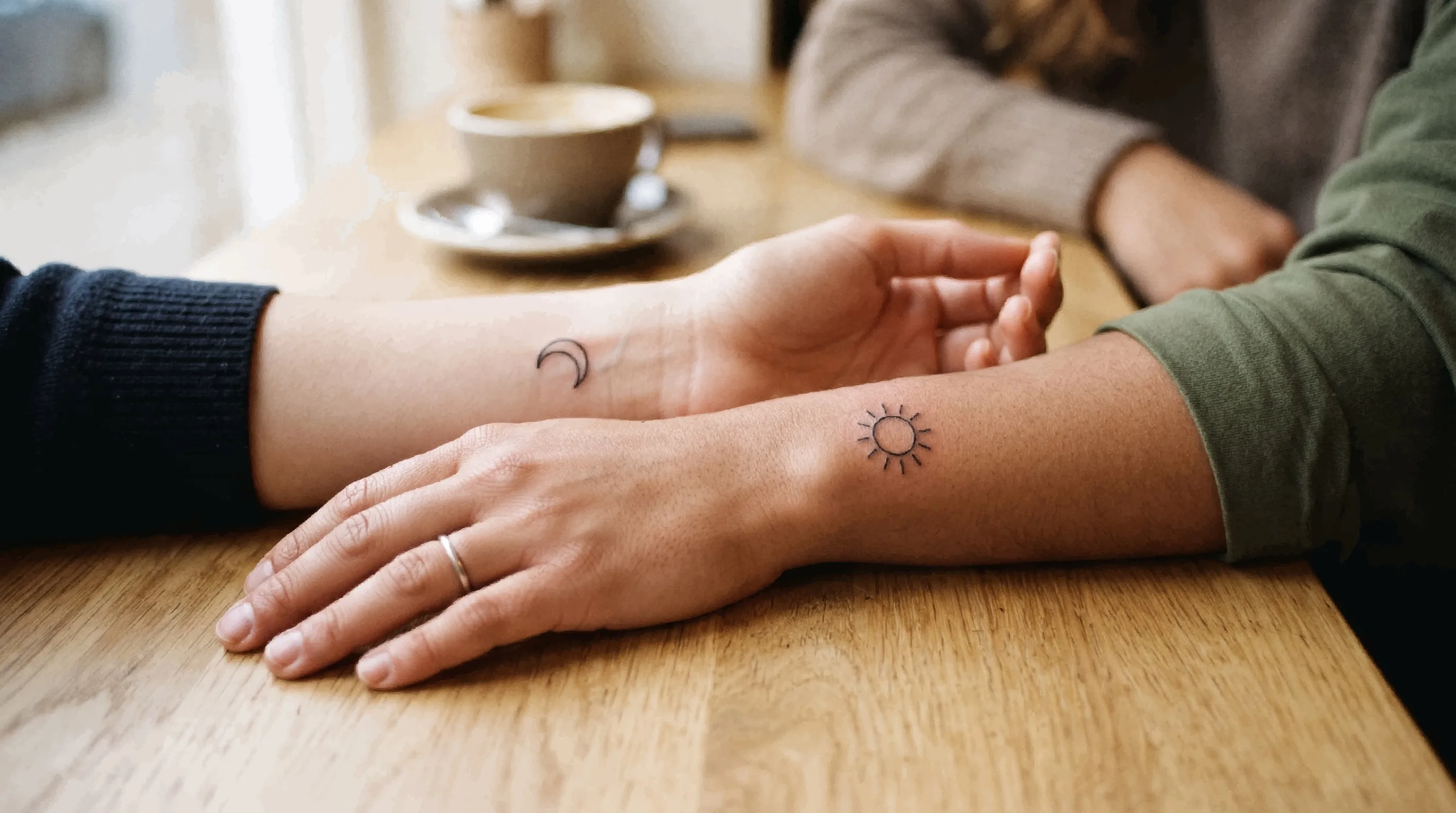
Two designs that belong together but are each complete on their own: a sun and a moon, a lock and a key, a mountain and a wave, two halves of a landscape. This is the approach artists most often recommend for couples, because each tattoo still makes sense by itself. If the other half is never in the room, nobody looking at yours would know anything is missing.
Same idea, different tattoos
The loosest version. You agree on a theme (the flower from your wedding, the bird you both love, the city where you met) and each person gets it in a style, size and spot that suits them. One of you might get a fine line sprig and the other a bold traditional bloom. It is the least obvious kind of matching tattoo, and often the one people are happiest with years later, because each person chose the version they actually wanted to wear.
Matching Tattoo Ideas That Hold Up
The ideas that last tend to come from something specific to you rather than a list. Still, it helps to see what has worked for other people. Use these as starting points, then make them your own.
For couples
- Coordinates or a skyline of the place you met, got engaged or first lived together.
- Complementary pairs: sun and moon, lock and key, arrow and bow, two puzzle pieces, two halves of a heart drawn so each half stands as a shape on its own.
- Each other's handwriting of one short word you both use. It reads as personal rather than as a name.
- A shared interest: a record you both love, a tiny camera, a climbing hold, a pair of hiking boots.
- Birth flowers for each other's month, which also work as two separate flower tattoos.
For best friends
- An inside joke turned into a small symbol: a food, an animal, an object from a trip.
- The place you grew up together, as a simple outline, a landmark or an area code.
- A shared trip, marked with a small motif from where you went. Getting it done while you are there is a classic, which our guide to destination tattoos covers.
- Matching flash picked from the same artist's sheet on the same day, which suits groups of three or more.
For siblings
- Something from your childhood home: a tree in the garden, the family pet, a favourite toy.
- A set: three birds for three siblings, each person getting one, or the same flower in a different colour each.
- Birth order as a pattern, such as dots or lines, where each sibling's version shows where they sit in the family.
For parents and children
- A drawing your child made when they were small, traced by the artist for both of you.
- A parent's handwriting from a card or letter, which is also one of the most common memorial tattoo ideas.
- A shared family symbol, such as a flower, a place or a heritage motif, in a size that suits each of you.
Most shared tattoos are small, so browsing minimalist tattoo ideas and our roundup of small tattoo ideas is a good way to find a shape you both like before you talk to an artist.
The Breakup Question: Designs That Still Work Alone
Nobody gets a couple tattoo expecting to split up, but artists see the other side of it all the time, and partner names are one of the most common reasons people look into covering or removing a tattoo. You don't have to plan for the worst. It is just worth picking a design that you would still be glad to have if life changes, whether that is a breakup, a falling-out with a friend, or simply growing older.
A simple test helps: would you still want this tattoo if the other person didn't have one? If the answer is yes, it is a good shared tattoo. If it only means something next to theirs, think again.
- Names and initials are the riskiest choice. They mean one thing only. If you want one anyway, many people wait until the relationship is years old, or choose something less direct, like a word in the other person's handwriting.
- Dates are a close second. An anniversary or a wedding date carries the same risk as a name. A place, a season or a symbol from that day keeps the memory without spelling it out.
- "Half a design" can go either way. A half-heart that only becomes a heart when you stand together looks unfinished alone. A sun that pairs with a moon looks complete either way.
- Pick something you each like the look of. If one of you is going along with the other's idea, that is the tattoo most likely to be regretted, whatever happens to the relationship.
If a shared tattoo stops fitting your life, there are options. A good artist can often rework it or cover it, and our guides to cover-ups and blast-overs and tattoo regret explain what is realistic. Small, simple linework is also the easiest kind of tattoo to cover later, which is one more reason it suits shared tattoos.
Size, Placement and Skin: Why Two Copies Won't Look Identical
Even with the same design, the same artist and the same day, two matching tattoos will never look exactly alike once they heal. That is normal, and it is worth expecting before you book so nobody is disappointed.
- Bodies are different sizes. A design that fills a slim wrist looks lost on a larger forearm. Artists usually scale a shared design to each person so it sits in proportion, even if that means one is slightly bigger.
- Skin takes ink differently. Skin tone, texture and how each of you heals all affect how lines settle and how colours show. Some colours that pop on lighter skin look softer on deeper skin, which our guide to tattoos on dark skin explains. Black linework is the most consistent choice across two people.
- Placement changes the shape. The inside of a wrist, the ankle and the back of the arm all curve differently. A design that sits flat on one person may wrap a little on the other.
- Tiny detail blurs. Very fine, very small designs soften over the years as ink spreads a little in the skin. If you want two tattoos that still look alike in ten years, keep them simple and give the lines room. Our articles on how big a tattoo should be and whether fine line tattoos fade go into the details.
Popular placements for shared tattoos are the inner wrist, the forearm, the ankle, behind the ear and the side of a finger. They are easy to show side by side in a photo, which is part of the appeal. Keep in mind that finger and hand tattoos fade faster than most, and that a visible spot is visible at work too. The placement guide compares pain, ageing and visibility across the body, and our guide to hand and finger tattoos covers why fingers are their own case.
You also don't both need the same spot. Plenty of pairs get the same design in different places, chosen by what each person is comfortable showing or sitting through.
Lettering and Script on Shared Tattoos
Words are popular for matching tattoos: a phrase from a song, a word in another language, a line one of you always says. They work well when a few things are right.
- Check the spelling and the translation. Read it out loud, have someone else check it, and if it is in a language neither of you speaks, have a native speaker confirm it means what you think.
- Keep it short. One to four words is usually the most a small matching tattoo can hold while staying readable as it ages.
- Pick a lettering style that suits small sizes. Tight cursive and very thin script close up over time. Our guide to tattoo lettering and script explains which styles hold up.
- Handwriting needs a clean source. If you are using each other's handwriting, write it several times on plain paper with a dark pen and let the artist pick the clearest version.
Booking Two People for the Same Tattoo
Booking a shared tattoo is mostly like booking any other, with a few extra things to sort out.
One artist or two? Most pairs book one artist for both tattoos, so the linework and style match. If you live in different cities, you can each book a local artist and send them the same design, but expect the two results to differ more. When you look for an artist, check their portfolio for clean, small work in the style you want. Our guide on how to find and choose a tattoo artist walks through what to look for.
Same day, one after the other. Artists usually tattoo one person while the other waits, so a pair of small tattoos is typically one longer appointment or two back-to-back slots. Tell the shop when you book that it is two people, so they set aside enough time. A big shop may offer two artists at once for larger groups.
Cost. Each tattoo is normally priced on its own, so two people pay for two tattoos. Small tattoos often fall under a shop minimum, which means a tiny matching tattoo can cost more per square inch than a bigger piece. Prices vary a lot by city and artist, and our guide to how much a tattoo costs explains minimums and hourly rates. Ask whether each person needs their own deposit and what happens if one of you can't make it; our article on tattoo deposits and cancellations covers what is normal.
Walk-ins and flash days. If you want something spontaneous, picking two pieces from an artist's flash sheet on a walk-in day is a fun way to do it. Our guide to flash vs custom tattoos explains how flash days work and when a custom design is worth the wait.
Both of you need to want it, sober. Artists see a steady stream of last-minute matching tattoo requests after a few drinks, and most will turn them away. A tattoo you both planned and slept on is the one you will both still like.
Heal on your own schedules. Two people tattooed on the same day may heal at slightly different speeds. That is normal; follow the aftercare your artist gives each of you, and check our week-by-week healing guide if one of you is worried.
Designing It Together
The hardest part of a shared tattoo is often agreeing on the design. A few things make it easier.
- Each make a shortlist first. Save five or ten images you like on your own, then compare. The overlap is usually where your design is.
- Talk about meaning before looks. Agree on what the tattoo is about, then find the image. It is much easier to choose between two drawings of the same idea than between two ideas.
- Try out variations. An AI tattoo designer is a quick way to see your idea in a few styles, or as a complementary pair, before you take it to an artist. Our guide on using AI to design your next tattoo explains how to get useful results. Treat it as a reference to show your artist, not the final stencil.
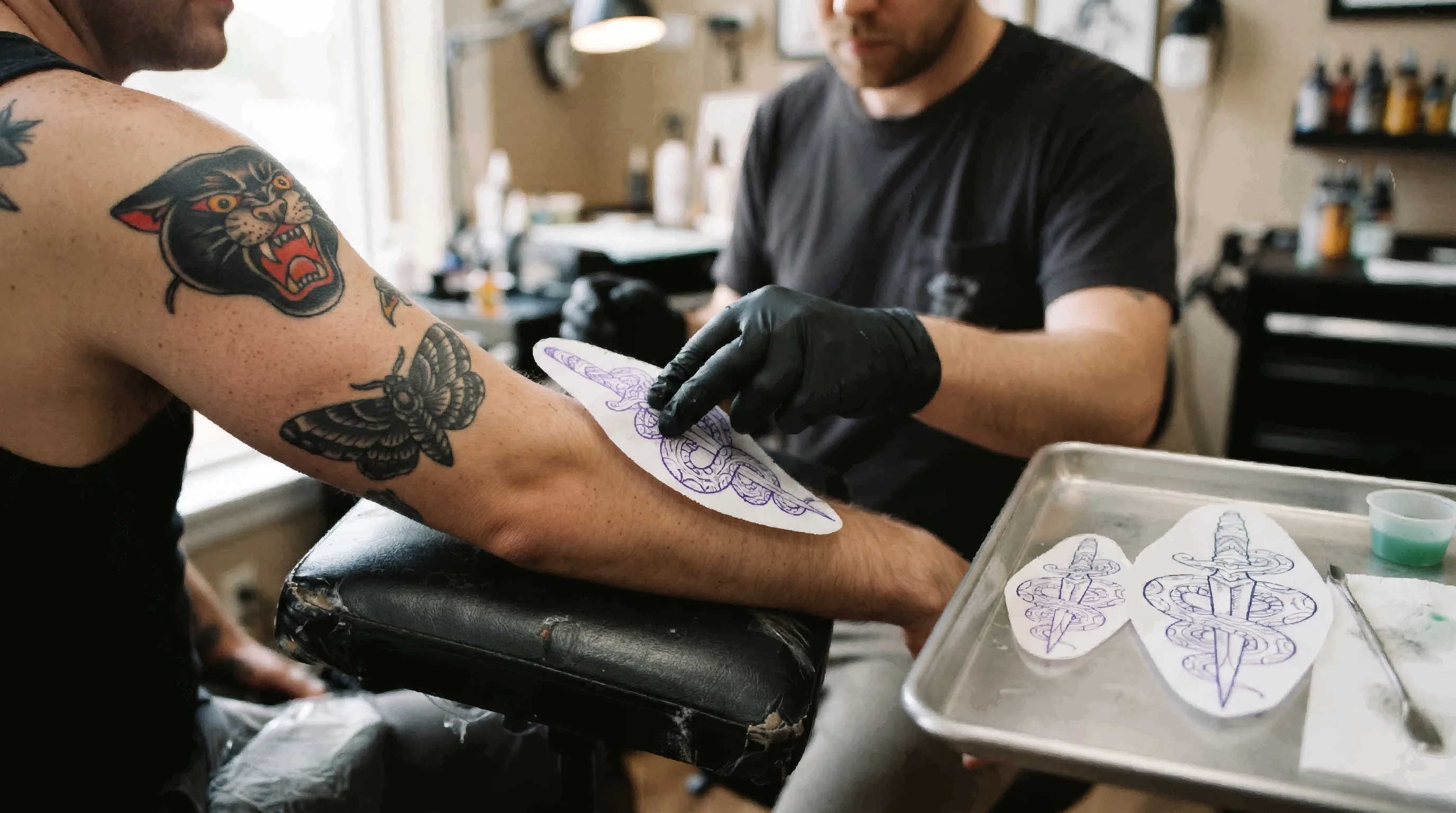
- Book a consultation together. Bring your references and tell the artist it is a shared piece. They will suggest how to adapt it to each of you. Our guide to the tattoo consultation lists what to bring and ask.
When you are ready, you can discover and contact tattoo artists on Tattooed.co, look through their work and message them about a tattoo for two.
Matching Tattoos With a Parent or Teenager
A parent and child tattoo is a popular milestone, often for an eighteenth birthday. If your child is still under 18, check the law before you plan it. Some US states allow tattoos for minors with a parent's consent, some ban them outright, and many artists refuse to tattoo anyone under 18 whatever the law says. Our guides to tattoo age laws in the US and around the world explain where things stand. For many families, the simplest plan is to choose the design now and book it for the day they turn 18.
Matching Tattoos FAQ
Are matching tattoos bad luck for couples?
No, that is a superstition. What causes regret is the design, not the idea. Names and dates are the choices people most often want covered later, so many couples choose a symbol, place or shared interest that would still mean something to each of them on its own.
What is the difference between matching and complementary tattoos?
Matching tattoos are the same design on both people. Complementary tattoos are two different designs that belong together, such as a sun and a moon or a lock and a key. Each complementary tattoo is complete on its own, which is why artists often recommend them for couples.
Can two people get tattooed at the same time?
Usually one artist tattoos one person after the other, so plan for a longer appointment or two back-to-back slots. Larger shops may be able to put two artists on it at once. Tell the shop it is a tattoo for two when you book, so they set aside enough time.
How much do matching tattoos cost?
Each person normally pays for their own tattoo. Small matching tattoos often fall under the shop minimum, so the price depends more on that minimum than on the size. Prices vary a lot by city and artist, so ask for a quote for both tattoos when you book.
Will our matching tattoos look exactly the same?
Not exactly. Different body sizes, skin tones, placements and healing all change how a tattoo looks once it settles. Artists often scale the design to each person so it sits in proportion. Simple black linework gives the most consistent result across two people.
Should I get my partner's name tattooed?
It is your choice, but names are the riskiest shared tattoo and among the most common requests for cover-ups. If you want one, many people wait until the relationship is well established, or choose something less direct, like a word in their partner's handwriting.