The consultation is the one part of getting tattooed that nobody prepares you for. You have spent weeks choosing an artist, and then you are sitting across from them with fifteen minutes to explain an idea that has only ever existed in your head. Most people walk out having forgotten half of what they meant to say and none of what they meant to ask. It does not have to go that way. A consultation is a short working meeting with a clear job, and if you arrive with the right material and the right questions, it is the single best predictor of whether you will love the finished piece.
This guide picks up where our guide on how to find and choose a tattoo artist leaves off. You have found someone whose work you want. Here is how to turn that into a design.
What a Consultation Is Actually For
From your side, a consultation feels like a chance to describe your idea. From the artist's side, it is an assessment, and they are answering several questions at once:
- Can this idea work as a tattoo? Not every image translates to skin. Detail that looks fine on a screen can blur into a smudge at the size you want it.
- Does it fit the placement? A design has to follow the shape and movement of the body part it sits on, and the artist needs to see that body part to judge it.
- Am I the right artist for it? A good artist will tell you when a piece belongs in someone else's hands.
- How long will it take? This is what the price and the number of sessions come from.
- Can we work together? A large piece means hours in a chair together, sometimes over months. Both of you are quietly checking whether that will be comfortable.
Everything you bring and everything you ask should help answer those questions. That is the whole trick.
Do You Even Need One?
Not always. A piece of flash from the artist's own sheet, a small walk-in, or a simple piece of lettering can usually be booked straight from a message or a booking form. Consultations earn their place when there is real design work or real uncertainty involved:
- Custom work of any size, drawn specifically for you
- Large pieces and multi-session projects such as sleeves and back pieces
- Cover-ups and reworks, where the artist has to see the old tattoo in person
- Tattoos over scars, stretch marks, or skin that has been treated
- Awkward placements such as hands, the neck, or anywhere the skin moves a lot
Consultations happen in three formats. In person is best for anything large, anything that depends on placement, and every cover-up. Video calls work well for traveling clients and artists with long waitlists. Written consultations, done through a booking form or a message thread, are increasingly common for mid-sized custom pieces, and they reward the preparation below even more, because the artist only knows what you write down.
Most consultations are free. Some busy artists charge a small fee to keep their calendar for serious clients, and that fee is usually credited toward your deposit or the final price. Ask which applies before you book the meeting.
What to Bring
Everything on this list exists to save the artist a guess. Every guess they have to make is a chance for the design to drift away from what you pictured.
A few references, with notes
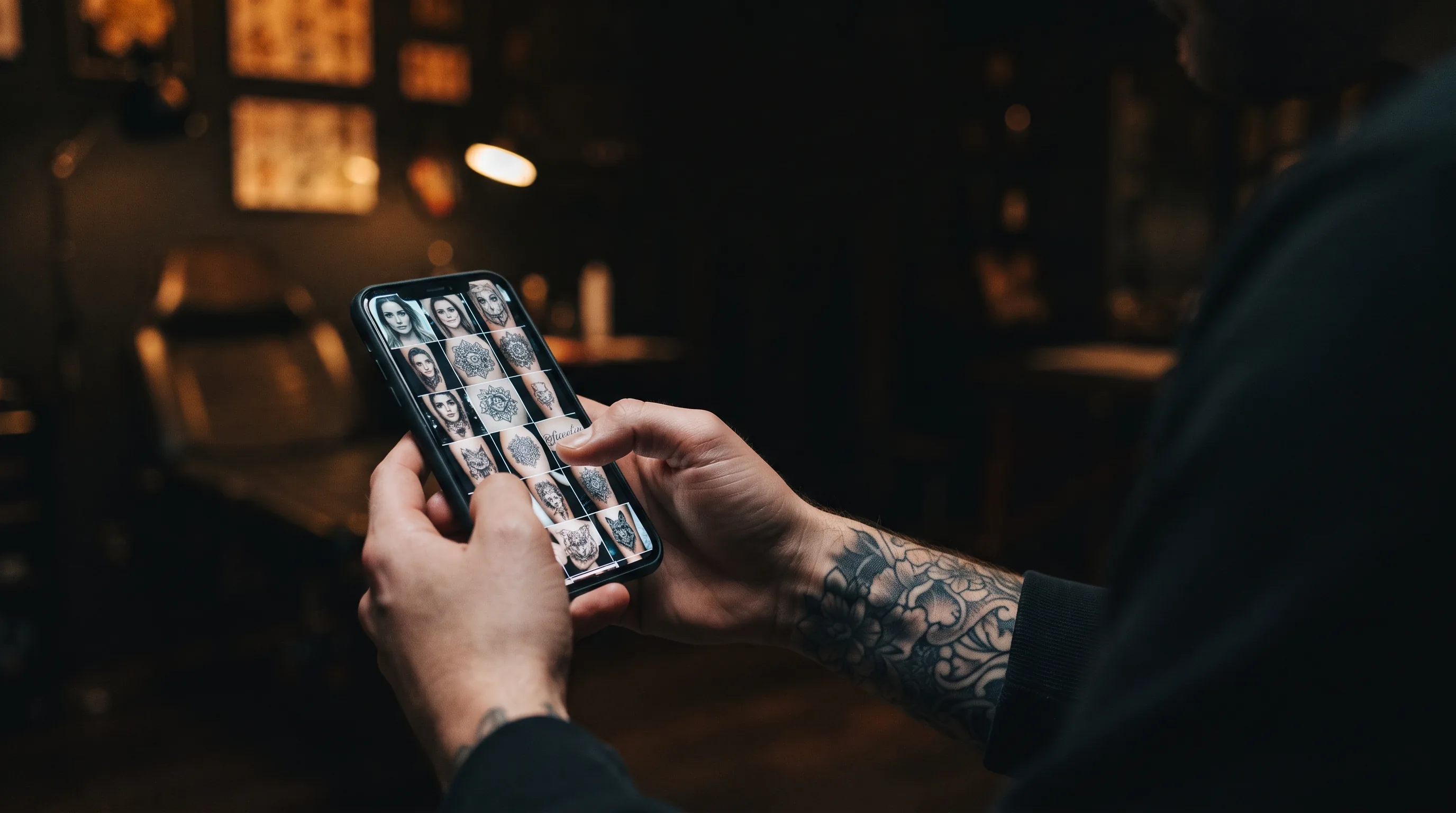
Three to five images is the useful range. More than that and the brief stops being a brief. The part people skip is the most important one: say what you like about each image. "The way the petals overlap in this one." "The heavy black shading in this one, not the subject." "This color palette." An artist looking at five unrelated photos with no notes has to work out what they have in common, and they may pick the wrong thing.
It is equally useful to bring one image of something you do not want. A reference that is close but wrong often explains your taste faster than three that are right.
An honest sense of size
"Medium" means nothing. "About the size of my palm" or "roughly four inches tall" gives the artist something to work with. Better still, print one of your references at the size you are imagining and hold it against the spot. Many people discover at this point that the detail they want needs a larger tattoo than they planned. That is far better learned now than on the day.
Clothes that give access to the placement
The artist needs to see the actual skin, how it curves, and what is already next to it. Wear something that lets you show the area easily. If you already have tattoos nearby, the new piece should work with them, so make sure those are visible too.
A budget range
People hold this back because they fear being quoted up to it. In practice, a range lets an artist design something that fits it, by adjusting size, detail, or the number of sessions, instead of designing freely and presenting a number that ends the conversation. Our guide to what a tattoo costs explains what drives the price if you are not sure what range is realistic.
For a cover-up: clear, current photos of the old tattoo
Take them in daylight, straight on, with nothing covering the tattoo. Bring them even to an in-person consultation. They let the artist plan later without calling you back in. Our guide to cover-ups and blast-overs explains why the old tattoo's darkness and size decide what is possible.
Exact wording for any lettering
Type it out, spelled and punctuated exactly as you want it inked. Double-check names, dates, and anything in a language you do not speak. The lettering and script guide covers how size and font choice affect whether script stays readable.
Anything medical that matters
Blood thinners, diabetes, pregnancy, eczema or psoriasis near the placement, and a history of keloid scarring all change how an artist plans a session. Mentioning them at the consultation avoids a cancelled appointment later. Our guide to tattoos and health conditions covers the common ones.
Using AI Images and Other Artists' Tattoos as References
Both are fine as a starting point. Both go wrong when they are treated as the finished design.
A photo of another artist's tattoo tells your artist the style and mood you like. Asking them to copy it line for line is a different request, and many artists will decline it, because that design belongs to the person who drew it and to the client who wears it. Expect a piece in the spirit of the reference, drawn for your body.
AI-generated images work the same way. They are good at showing an artist a subject, a composition, or an atmosphere quickly, and they are often poor at the things that make a tattoo hold up: line weight, contrast, and detail that survives at real size. Present one as a concept, not a stencil. Our guide on using AI to design a tattoo covers how to get the most useful images out of those tools.
Questions Worth Asking
Write these down before you go. It is remarkably easy to leave without the answers otherwise.
About the design
- "When will I see the design?" Many artists only finish the drawing in the days before the appointment, and some show it for the first time on the day. That is normal, but you should know which to expect.
- "How do changes work?" Ask how many rounds of revisions are included, and whether changes on the day are possible.
- "Would you change anything about this idea?" The most useful question on the list. An artist's honest answer about size, placement, or detail is exactly the expertise you are paying for.
About time and money
- "Is this priced by the hour or as a flat rate?" Both are common. Our guide to tattoo pricing explains the difference.
- "How many sessions do you expect, and how far apart?" Large pieces need healing time between sessions, so a sleeve is a calendar commitment as well as a financial one.
- "What is the deposit, and what is the cancellation policy?" Get it in writing. Our guide to deposits and cancellations covers what is normal.
About the work itself
- "Do you have a healed photo of something similar?" Fresh photos show the day it was done. Healed ones show what you will actually live with. Our guide to reading a tattoo portfolio explains what to look for.
- "Is a touch-up included?" Many artists include one free touch-up within a set period. Our guide to touch-ups covers when you are likely to need one.
- "Which aftercare do you recommend?" Artists have preferences, and following your artist's routine makes a touch-up conversation simpler if something heals unevenly.
- "Are you OK with numbing cream?" Some artists allow it and some do not, because certain products change how the skin takes ink. Ask now, not in the chair. Our guide to numbing cream explains why.
What the Artist Will Ask You
Expect a few questions in return. Having answers ready makes the meeting shorter and the design better.
- Why this design? Not an interrogation. A tattoo that carries a story is often designed differently from one chosen for how it looks.
- How flexible are you? Say honestly whether you want this exact idea or are open to the artist's interpretation. Both are fine, and the answer changes how they approach it.
- Is this your first tattoo? It affects how they plan the session length, especially for a large or painful placement.
- How visible does it need to be, or not be? If work or family means you need to cover it, say so. It can decide the placement.
Good Signs and Warning Signs
The consultation is your best look at how an artist works before you have paid for anything. Some of the most reassuring signs look like obstacles at first.
- Good sign: they push back. An artist who says the piece needs to be bigger, the lettering thicker, or the placement moved is protecting how the tattoo will look in ten years. Being told no is rarely a bad outcome.
- Good sign: they refer you elsewhere. An artist who says a piece is outside their style, and names someone better suited, is being honest about their skills.
- Good sign: clear answers on price, process, and policy. A range, not a promise, is fine. Vagueness about everything is not.
- Warning sign: pressure to pay a deposit on the spot. You should be able to go away and think about it.
- Warning sign: no interest in your references or your reasons. If they are not listening now, they will not listen when the stencil goes on.
- Warning sign: no healed work to show. Especially for the specific style you are asking about.
- Warning sign: saying yes to everything. Tiny, hyper-detailed fine line on a finger, with no caveats at all, suggests someone who will not be around when it blurs.
After the Consultation
If you are going ahead, the usual next step is the deposit, which secures the appointment and pays for the drawing time. Then the artist designs, which can take anywhere from a few days to several weeks depending on their calendar and the size of the piece. Resist the urge to send new references every few days while they work. If something important changes, say it once, clearly.
On the day, you will see the design and then a stencil placed on your skin. This is your last easy chance to adjust the size or position, so look at it in a mirror, move around, and speak up if something feels off. Adjusting a stencil takes a few minutes. Living with a crooked tattoo takes decades. Our checklist for preparing for your appointment covers the days leading up to it.
If you are still looking for the right person to consult with, you can browse tattoo artists on Tattooed.co by style and location, compare their galleries, and send a booking request straight from their profile.
Tattoo Consultation FAQ
Do tattoo consultations cost money?
Most are free. Some in-demand artists charge a small consultation fee to filter out casual inquiries, and it is usually credited toward your deposit or the final price if you go ahead. Ask when you book the consultation, so it is not a surprise.
How long does a tattoo consultation take?
Usually 15 to 30 minutes. Large projects, sleeves, and cover-ups can run longer because there is more to measure and discuss. Arriving with references, a size, and a budget range already worked out is the easiest way to keep it short and productive.
What should I bring to a tattoo consultation?
Three to five reference images with notes on what you like about each, a realistic idea of the size, clothing that lets the artist see the placement, a budget range, and your written questions. For a cover-up, bring clear daylight photos of the old tattoo. For lettering, bring the exact wording, spelled as you want it.
Will I see my tattoo design at the consultation?
Usually not. The consultation is where the artist gathers what they need to draw the design. Many artists finish the drawing in the days before the appointment, and some show it for the first time on the day. Ask at the consultation when you will see it and how changes are handled.
Can I bring someone with me to a tattoo consultation?
Usually yes, though it is polite to ask first, since some studios are small. One person is plenty. The consultation works best when the conversation is between you and the artist, so bring someone for support rather than a second opinion on the design.
Is it OK to consult with more than one tattoo artist?
Yes, especially for a large or expensive piece. Consulting with two artists before choosing one is normal and professional. What is not fair is asking several artists to draw a full custom design on spec. Choose your artist first, then commission the drawing.