Somewhere between "definitely get it" and "total waste of money," numbing cream has become one of the most argued-about topics in tattooing. The honest answer is more useful than either extreme: it works, within real limits, and whether it belongs in your appointment depends on the product, the placement, and — more than either of those — what your artist is actually willing to work over.
How Numbing Products Actually Work
Tattoo numbing products are topical anesthetics — the same broad category of drug used in dental gels and minor-procedure creams, just formulated for skin that's about to take a needle repeatedly rather than a single injection. The active ingredients, most commonly lidocaine, prilocaine, tetracaine, or benzocaine, work by temporarily blocking the sodium channels nerves use to send pain signals to your brain. Applied and absorbed properly, the surface layer of skin genuinely goes numb — this isn't a placebo product category.
What it doesn't do is switch off sensation entirely at every depth a tattoo needle reaches. Topical anesthetics work at the surface. A tattoo needle moves in and out of the skin repeatedly, deeper than a topical product fully penetrates, which is why most people describe numbed skin as "duller" and "more tolerable," not "nothing at all."
The Two Main Types: Before vs. During
Not all numbing products are meant for the same stage of your appointment, and using the wrong one at the wrong time is where most bad experiences come from.
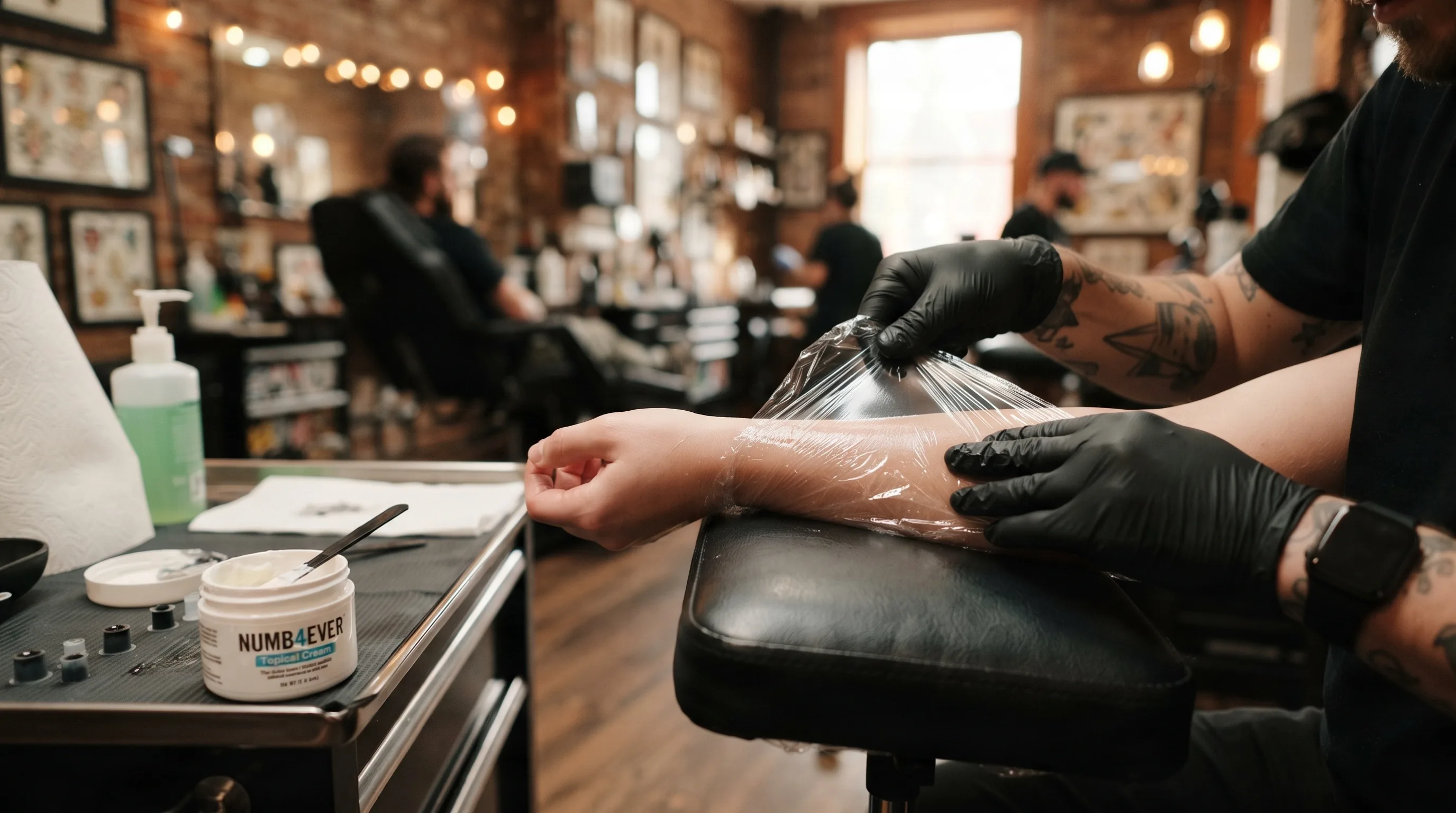
- Pre-tattoo creams (unbroken skin). Applied 45 to 60 minutes before your session under plastic wrap to create an occlusion seal, then wiped off before the artist preps the area. These are the most common and the ones most artists have at least some familiarity with.
- Mid-session sprays and gels (broken skin). A separate category formulated specifically for skin that's already being tattooed, used to extend or refresh numbness partway through a longer session. These are not the same product as a pre-session cream, and using a standard intact-skin product on broken skin is not what it's designed or tested for.
What It Can Realistically Do — and What It Can't
Set expectations correctly and numbing cream is a genuinely useful tool. Oversell it to yourself and you'll be disappointed halfway through the appointment.
- It lowers your starting pain level. Most people report a real, noticeable reduction in the first stretch of the session, particularly on the placements that hurt the most — ribs, hands, feet, inner arm.
- It fades mid-session. Standard pre-tattoo products typically hold for one to two hours before wearing off. On a longer sitting, the second half of your appointment will likely feel closer to normal than the first.
- It doesn't prevent the "rebound." Some clients report that once a vasoconstrictor-based product wears off, sensation returns more sharply than it would have without any numbing at all — worth knowing going in, not discovering three hours into a large piece.
- It won't fix a placement you're dreading. Numbing cream takes the edge off; it doesn't turn a genuinely painful spot into an easy one.
The Epinephrine Trade-Off Few People Mention
Many tattoo-specific numbing products add a secondary ingredient — usually epinephrine — on top of the anesthetic itself. Epinephrine constricts blood vessels at the site, which is marketed as a bonus: less bleeding, cleaner ink saturation during the session. That part is often true.
The trade-off is what happens when it wears off. Constricted vessels open back up all at once, which can bring a rush of bleeding and a sharper return of sensation than a plain anesthetic would produce. It's also the specific mechanism several experienced artists point to when they say a numbed area "tattoos differently" — the skin's normal blood flow and texture are temporarily altered while the product is active, which affects how it responds to the needle.
Why Some Artists Say No
This isn't artists being difficult — it's a real, recurring concern with a real cause.
- Altered skin feedback. Experienced artists rely partly on how skin responds under the needle to judge depth and pressure. Numbed, vasoconstricted skin can feel different, making that feedback less reliable.
- Swelling and blanching. Some products cause visible puffiness or a pale, waxy look at the site. On fine linework or detailed shading, that distortion can genuinely affect precision.
- Undisclosed use. An artist who wasn't told a numbing product was applied, and notices unusual bleeding, texture, or a reaction partway through, is now solving a problem blind. This is the single biggest reason artists ask you to disclose it upfront.
- Shop or studio policy. Some shops have a blanket no-numbing-products policy regardless of the individual artist's opinion, often shaped by past bad experiences with walk-in clients who didn't disclose use.
How to Use It the Right Way
If your artist is on board, using it well comes down to timing and disclosure more than the specific product you choose.
- Ask before you book, not the morning of. Bring it up when you're scheduling or confirming your appointment, so there's no last-minute back-and-forth in the chair.
- Patch test days ahead. Apply a small amount to unrelated skin at least a day or two before your appointment to rule out an allergic reaction before it matters.
- Follow the product's actual instructions. Occlusion time, application thickness, and skin prep vary by brand — a generic rule of thumb is a worse guide than the label in front of you.
- Arrive with clean, product-free skin at the actual tattoo prep stage. The cream needs to be fully wiped away before your artist preps and stencils the area — residue left behind can interfere with both.
- Never reapply on your own mid-session. If you want more coverage during a long sitting, that's a conversation with your artist, not something to do quietly in the bathroom.
Safety Limits You Shouldn't Ignore
Topical anesthetics are genuine medications, not cosmetics, and the safety guidance that comes with them exists for a reason.
- More is not better. Applying a thicker layer or covering a larger area than the label recommends increases how much anesthetic actually absorbs into your bloodstream — it doesn't make the numbing stronger or last longer in a way that's worth the added risk.
- Don't stack products. Combining more than one numbing product, or applying a fresh layer before the last one has worn off, can push absorbed dose higher than either product's label was tested for.
- Watch for symptoms, not just discomfort. Ringing in the ears, dizziness, a metallic taste, or unusual sleepiness after applying a topical anesthetic are signs to stop and seek medical attention, not push through.
- Check with a doctor or pharmacist if you're pregnant, have a heart condition, or take other medications — the same category of caution covered in our guide on tattoos and specific health conditions.
None of this is medical advice — it's a starting orientation. If you have questions about a specific product or your own health history, a pharmacist or doctor is the right person to ask, not a tattoo shop.
Always Loop In Your Artist First
The single decision that matters more than which product you pick is whether your artist knows about it before the needle touches your skin. Some artists have a preferred brand they're comfortable working over. Others have been burned before and will say no outright. Either answer is worth getting in advance — a five-minute message when you book saves both of you a conversation you don't want to be having mid-session.
Tattoo Numbing Cream FAQ
Does numbing cream really work for tattoos?
It genuinely dulls the initial sting for most people, but it does not eliminate sensation entirely. Expect a noticeably lower starting pain level that fades as the anesthetic wears off partway through the session — it works better as a way to take the edge off than as a promise of a pain-free tattoo.
Can I use numbing cream on any tattoo placement?
Most over-the-counter numbing products are approved for use on intact, unbroken skin, which covers the vast majority of tattoo placements. Always check the product label for placement restrictions, and never apply it near the eyes, mouth, or any area with broken or irritated skin.
Will numbing cream affect how my tattoo turns out?
It can, which is exactly why some artists decline to work over it. Vasoconstrictor ingredients can change how the skin behaves under the needle, and swelling or blanching from certain products can distort fine detail. This is a real enough concern that you should always ask your artist before applying anything, not after.
How long before my appointment should I apply numbing cream?
Most occlusion-based creams need roughly 45 to 60 minutes under plastic wrap to fully absorb before they are wiped off and the skin is prepped. Timing varies by product, so follow the specific instructions on your product rather than a generic rule, and always confirm your artist is fine with the product before you use it.
Is it safe to reapply numbing cream during a long session?
Only with a product specifically formulated for broken or actively tattooed skin, and only with your artist's knowledge. Reapplying a standard intact-skin product over fresh tattoo work is not what it is designed for and increases the risk of excess absorption. Never apply more product on your own mid-session without checking first.