A small, simple tattoo can be finished in well under an hour, while a full sleeve or back piece can take dozens of hours spread over many months. Most people land somewhere in between: a palm-sized piece usually takes one to three hours of actual tattooing, and the appointment itself runs longer than that once you add paperwork, stencilling and setup. Your artist is the only person who can give you a real estimate for your design, but knowing what drives the time makes that estimate much easier to understand and plan around.
The Short Answer
As a rough guide, and with plenty of variation between artists and designs:
- Very small and simple (a word, a symbol, a small outline): around 15 minutes to an hour.
- Small to palm-sized with some shading or detail: roughly one to three hours.
- Medium pieces (half a forearm, a calf, a shoulder): often three to six hours, sometimes split over two sessions.
- Half sleeves: commonly two to four sessions.
- Full sleeves: often somewhere in the region of 15 to 40 hours or more, over several sessions.
- Full back pieces and bodysuits: can run well past that, across many months or even years.
Add 30 to 60 minutes on top of the tattooing time for the first part of the appointment (forms, stencil, placement and setup), and a little at the end for cleaning and wrapping. If someone tells you a tattoo "takes two hours", they usually mean two hours of needle time, not two hours door to door.
What Happens in the Time You're Booked For
A lot of first-timers are surprised that they sit in the studio for a while before the machine even starts. That time is part of the job, and rushing it makes the tattoo worse. A typical appointment runs roughly like this:
- Check-in and paperwork. ID, a consent form and some health questions. A few minutes if you have filled things in online beforehand, longer if not.
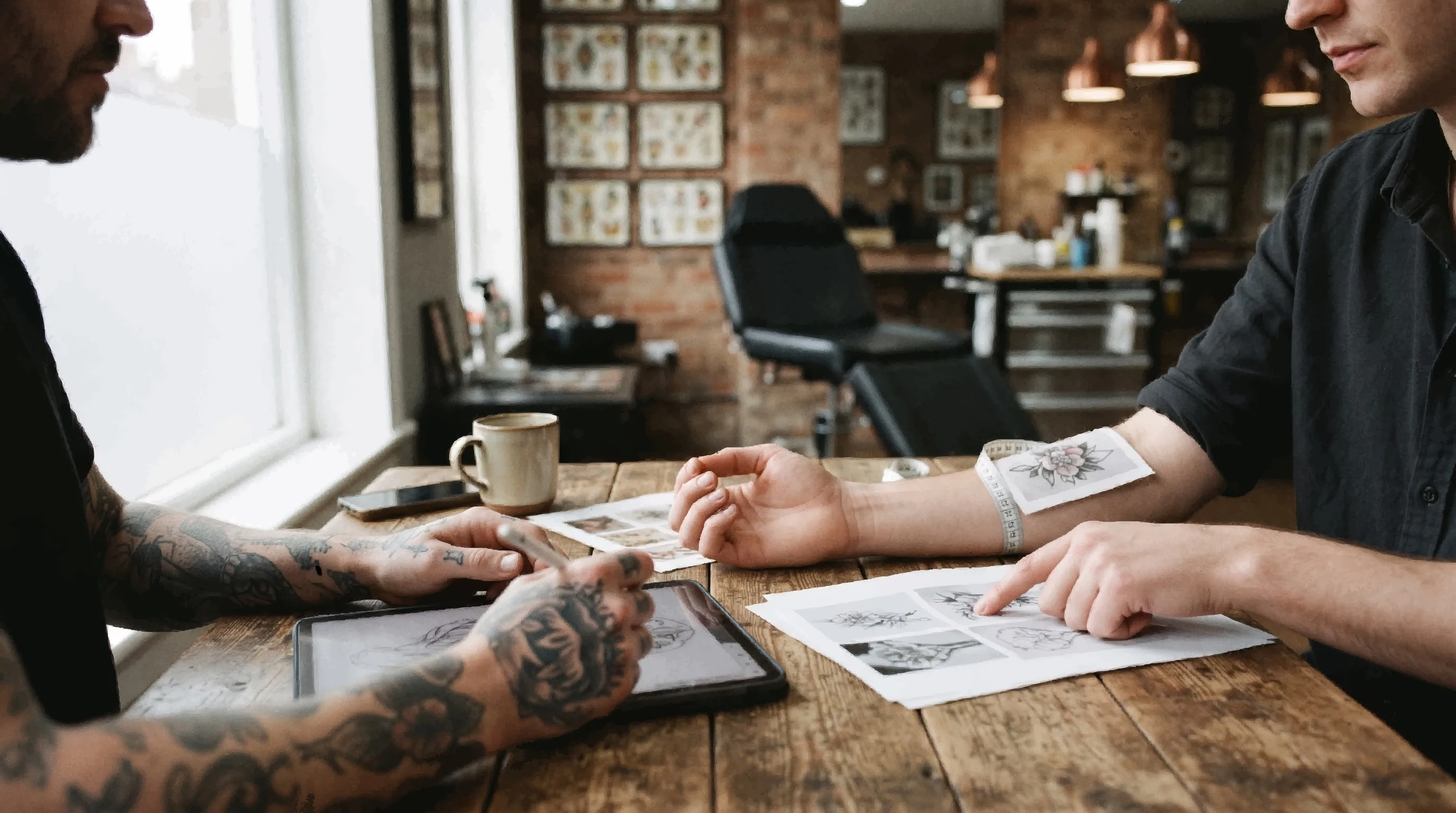
- Final design check. Many artists finish the drawing before the day, but small changes (size, a detail, how it sits) often happen here. If the design still needs real work, this can take a while.
- Stencil and placement. The artist prints a stencil, shaves and cleans the area, and applies it. Getting placement right on a curved arm or a ribcage can take a few attempts. This is the moment to speak up if it does not look right in the mirror; a stencil comes off easily, a tattoo does not.
- Setup. The artist lays out ink, needles and barrier film for a clean workstation. Usually 10 to 20 minutes, often while the stencil sets.
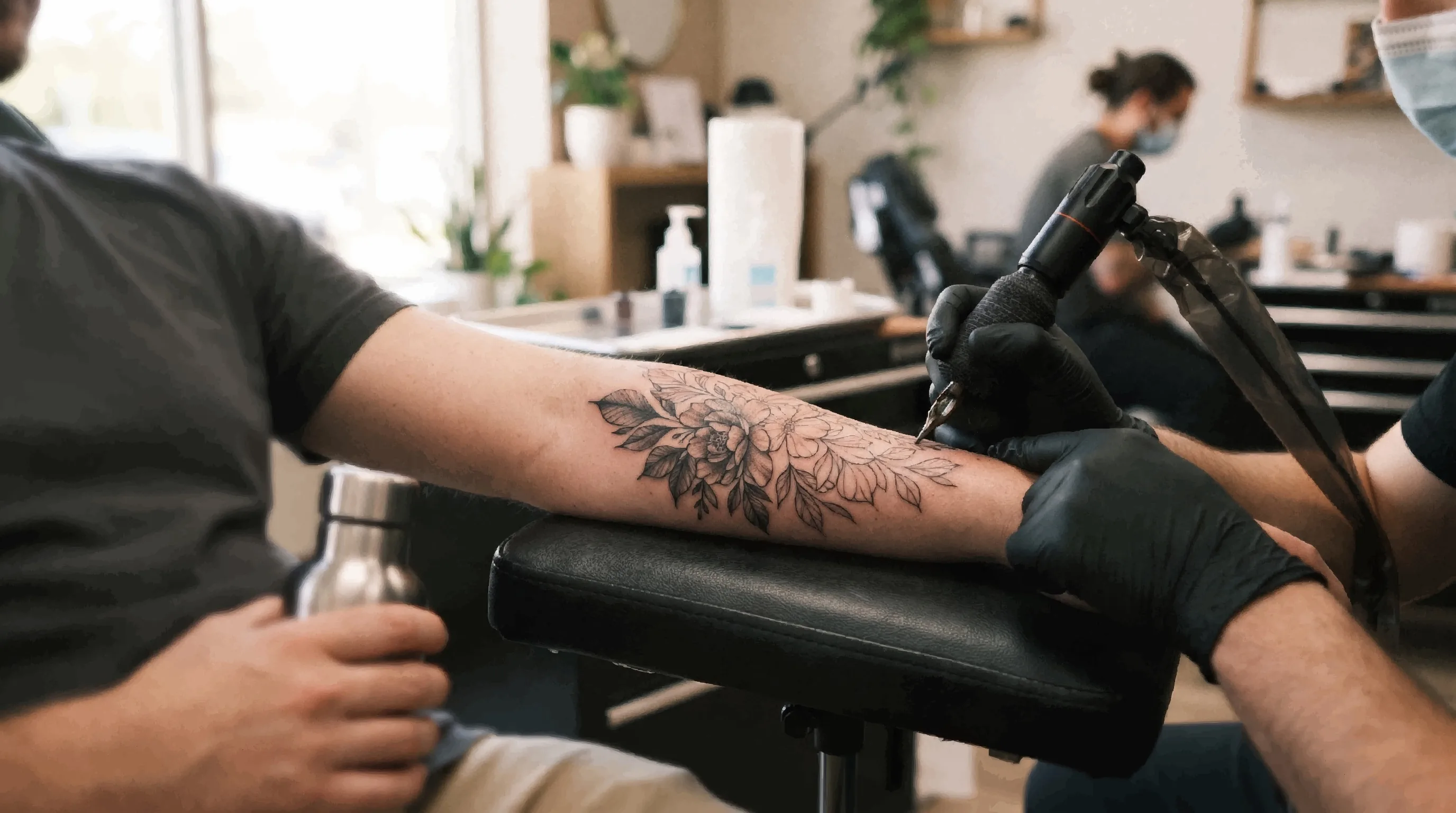
- Tattooing. The part everyone thinks of, broken up with short breaks on longer sessions.
- Clean-up and wrap. The tattoo is cleaned, photographed and covered, often with a film like second skin, and you get your aftercare instructions.
Our guide to preparing for your tattoo appointment covers what to do the day before so the first half of this goes quickly.
Typical Times by Size
Size is the biggest single factor, but it is not a straight line. Doubling the width of a design roughly quadruples the area to fill, and a larger canvas usually invites more detail too. These are loose ranges to plan around, not quotes.
Tiny and minimalist tattoos
Initials, a date, a small heart or a fine outline are often finished in under an hour, sometimes in 15 minutes. The setup can take longer than the tattoo. This is why many studios have a shop minimum charge: the artist's time and materials are the same whether the design takes ten minutes or forty. If you are thinking small, our small tattoo ideas are a good place to start.
Palm-sized pieces
A design about the size of your palm, with linework and some shading, usually takes one to three hours. A bold, simple traditional piece sits at the quick end; a detailed black and grey portrait at the same size can take far longer.
Medium pieces
Half a forearm, an outer calf, a shoulder cap or a thigh piece is where times spread widely, from around three hours to a full day. Many artists split anything over five or six hours into two sessions, partly for your comfort and partly because skin that has been worked on for hours gets swollen and harder to tattoo cleanly.
Sleeves, back pieces and large-scale work
Large projects are measured in sessions rather than hours. A half sleeve commonly takes a few sessions, a full sleeve many more, and a back piece more again. How many depends heavily on style and how dense the design is. Our guide to planning a tattoo sleeve goes into how artists break large work into stages.
What Makes a Tattoo Take Longer
Two designs of the same size can take very different amounts of time. These are the main reasons.
Style and detail
Bold traditional work with strong outlines and flat colour is relatively quick for its size. Realism, fine detail, soft gradients and micro-realism take much longer, because the artist builds tone gradually in many light passes. Dotwork and stippling are slow by nature, since every dot is placed. Our guide to tattoo styles explains what each one involves.
Colour versus black and grey
Colour usually adds time. Each colour needs its own ink and often its own passes, and solid colour has to be packed evenly into the skin so it heals without patches. Large areas of solid black take time for the same reason. The black and grey vs. colour guide covers the other trade-offs.
Placement and skin
Flat, firm areas like the outer forearm or calf are the easiest to work on. Ribs, stomach, inner arms, necks, hands and feet take longer: the skin is thinner, softer or stretchier, it moves with breathing, and the artist often has to stretch it carefully and slow down. Very sensitive spots also mean more breaks. Our tattoo pain guide by body part shows which areas tend to be hardest to sit for.
Skin that has been tattooed before, is scarred, or is being covered up can also slow things down. A cover-up often takes longer than a fresh tattoo of the same size, because the new design has to be built to hide the old one.
The artist
Some artists simply work faster than others, and speed is not the same as quality in either direction. A careful artist who takes their time on linework is not necessarily slow, and a quick one is not necessarily cutting corners. What matters is the healed result, which is why it is worth knowing how to read a tattoo portfolio before you book.
You
How still you can sit, how often you need a break, and how your skin reacts all affect the clock. Skin that bleeds more (after alcohol, for example, or with certain medications) is harder to see through and can slow the work down. A client who is tired, hungry or anxious tends to need more breaks, too.
How Long Can One Session Last?
Most sessions run somewhere between two and six hours. Some artists and clients do longer days of seven or eight hours for big projects, and a few artists offer all-day sessions, but they are demanding on both sides.
There are good reasons not to push a single session too far:
- Pain builds. Most people find the first hour or two manageable and the later hours harder, as the skin gets more tender and your body tires.
- Skin swells. After hours of work, the area becomes puffy and irritated, which makes clean lines and smooth shading harder to achieve.
- Healing is harder. A very large fresh area is a lot for your body to heal at once.
- The artist gets tired too. Steady hands and good judgement matter for the whole session.
If this is your first tattoo, a shorter session is usually the better choice. Our first-timer's guide has more on what to expect. Some people consider numbing cream for long sessions; our guide to tattoo numbing cream explains when it helps and why you must check with your artist first.
Multi-Session Tattoos and the Gaps Between
Large tattoos are usually done in stages. A common pattern is linework or outlining first, then shading and colour in later sessions, though many artists work section by section instead.
Between sessions, the tattooed area needs to heal before the artist works on it again. Artists commonly leave at least a few weeks between sessions on the same area, and often longer. Working on skin that has not finished healing is harder and gives worse results. The week-by-week healing guide explains what is happening in that time.
In practice, the total timeline for a big piece is shaped as much by scheduling as by healing. Popular artists can be booked weeks or months ahead, so a sleeve can easily stretch over a year. Booking several sessions at once, if your artist allows it, keeps the project moving. Be aware that each session may need its own deposit, and that missing one can cost you it.
Time and Cost: How They're Linked
Time is the main thing you are paying for. Artists price in one of three common ways:
- By the hour, common for medium and large work. Hourly rates vary a lot by city, experience and demand.
- By the piece, a fixed price agreed in advance, common for smaller tattoos and flash.
- By the day or session, often used for big projects with long sittings.
If you are paying by the hour, the time estimate is effectively the price estimate, so ask for both at your consultation. Ask whether breaks and setup are included in the hourly charge, too. Our guides to how much a tattoo costs and tattoo pricing go into detail.
Treat any estimate as a range. An artist who says "about three hours" is making a judgement, and it can run over if the skin is tricky or you need more breaks. A faster artist is not automatically cheaper either, if their hourly rate is higher.
How to Help Your Session Go Smoothly
You cannot make the artist faster, but you can avoid adding time and make the hours easier to sit through:
- Sleep well the night before and eat a proper meal an hour or two beforehand. Low blood sugar makes people faint and fidgety.
- Skip alcohol for at least the day before. It can thin the blood and increase bleeding.
- Bring water and a snack for anything over two or three hours.
- Wear clothes that give easy access to the area and that you do not mind getting ink on.
- Bring headphones, a book or a charged phone for long sittings, and check the studio is happy with that.
- Keep still, and ask for a break rather than squirming. Artists would much rather pause than fight a moving target.
- Arrive on time, with ID and anything your artist asked you to bring. A late start often means a shorter session, not a later finish.
The tattoo etiquette guide covers the rest of being a good client, from bringing friends to asking for breaks.
Planning the Rest of Your Day
Block out more time than the estimate. If your artist says three hours, plan for four or five from arrival to leaving, and do not book anything important straight afterwards. Sessions can run long, and you may feel tired, sore or a little shaky once the adrenaline wears off.
For longer sessions, think about the next day as well. A big fresh tattoo can feel like a bad sunburn, and some areas (feet, the back of the knee, the ribs) make the following day uncomfortable. Avoid scheduling heavy exercise, swimming or a long flight right after.
If you are still at the stage of picking a design, the AI tattoo designer can help you try out ideas and sizes before you sit down with an artist. When you are ready to book, you can discover and contact tattoo artists on Tattooed.co, look through their work, and ask each one how long your design would take.
How Long Does a Tattoo Take FAQ
How long does a small tattoo take?
A very small, simple tattoo such as a word, initials or a small outline often takes between 15 minutes and an hour of tattooing. Expect the whole appointment to take longer, because paperwork, stencilling and setup can take 30 minutes or more before the artist starts.
How long does a full sleeve take?
A full sleeve often takes somewhere in the region of 15 to 40 hours of tattooing or more, depending on the style, detail and amount of colour. It is almost always split over several sessions a few weeks or more apart, so the whole project can take months or longer.
What is the longest a tattoo session should last?
Most sessions last between two and six hours. Some artists do longer days for large projects, but pain, swelling and tiredness all build as the hours go on. For a first tattoo, a shorter session is usually the better choice. Your artist will tell you what they think is sensible for the design.
Why does my tattoo appointment take longer than the tattoo itself?
Before tattooing starts, there is paperwork, a final check of the design, shaving and cleaning the area, placing the stencil and setting up a clean workstation. Afterwards the tattoo is cleaned and wrapped. All of this is part of a safe, well-placed tattoo, and it often adds 30 to 60 minutes.
Does a colour tattoo take longer than black and grey?
Usually, yes. Colour needs separate inks and often extra passes, and solid colour has to be packed evenly so it heals without patches. Detailed black and grey realism can also be slow, though, so style and detail matter as much as whether the tattoo is in colour.
How long should I wait between tattoo sessions?
Artists commonly leave at least a few weeks between sessions on the same area, so the skin can heal first. Many prefer longer. Your artist will set the gap based on how your skin heals and how busy their schedule is.