Pain is one of the first questions people ask before getting a tattoo, and one of the hardest to answer honestly. The truthful version is: it depends. It depends on your individual pain tolerance, the size of the piece, how long the session runs, and — most importantly — where on your body the tattoo goes. While no two people experience tattooing exactly the same way, certain body areas are consistently more or less painful, and the reasons why are well understood. This guide breaks it all down so you can walk into your appointment with accurate expectations instead of anxiety.
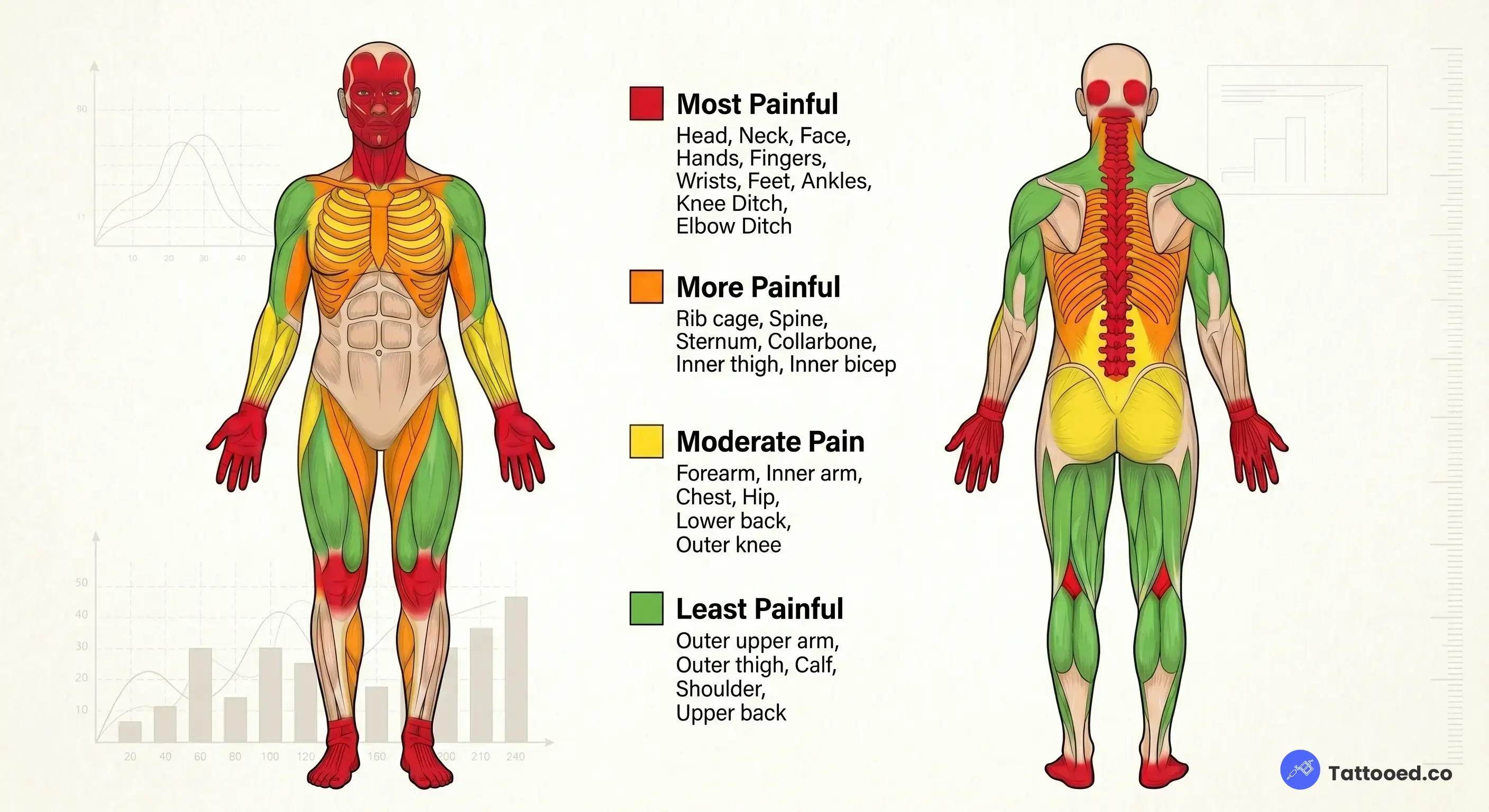
Quick Reference: Tattoo Pain by Body Area
- Least painful: Outer upper arm, outer thigh, calf, shoulder, upper back
- Moderate pain: Forearm, inner arm, chest, hip, lower back, outer knee
- More painful: Rib cage, spine, sternum, collarbone, inner thigh, inner bicep
- Most painful: Hands, fingers, wrists, feet, ankles, knee ditch, elbow ditch, head, neck, face
Pain is also cumulative — areas that are moderate at the start of a two-hour session can feel significantly more intense by the end. Keep that in mind when planning your first long sitting.
Why Do Some Areas Hurt More Than Others?
Three factors explain most of the variation: nerve density, proximity to bone, and skin thickness.
- Nerve density: Areas with high concentrations of nerve endings — hands, feet, face, inner arms — transmit more pain signals per needle pass. Your nervous system is doing its job.
- Bone proximity: When the needle works over a thin layer of skin directly above bone — ribs, spine, collarbone, knees, ankles — the sensation is sharper and more intense. There's less tissue to absorb the impact.
- Skin thickness and padding: Areas with more muscle and fat act as natural shock absorbers. The outer thigh and shoulder blade, for example, have enough padding that the sensation stays dull and manageable for most people throughout even a long session.
Least Painful Areas
These placements are consistently reported as the most tolerable, especially for longer sessions. They're often recommended for first tattoos precisely because the experience is manageable without being a rite of passage in the worst sense.
- Outer upper arm: Well-padded, low nerve density, and easy for the artist to access. One of the most popular placements for a reason.
- Outer thigh: Large surface area, thick skin, minimal nerve concentration. A strong choice for anyone who wants a larger piece without a brutal session.
- Calf: Meaty, away from bone, and surprisingly forgiving. The only caveat is that the shin itself — the front of the lower leg — is a different story entirely.
- Shoulder: The upper shoulder and the cap of the shoulder are well-padded and generally low on the pain scale. The collarbone area nearby is a sharp contrast.
- Upper back / shoulder blades: Large, flat, well-cushioned canvas. Pain tends to increase as you move toward the center of the spine.
Moderately Painful Areas
These placements are doable for most people — painful but not overwhelming — and are generally considered a normal part of the tattooing experience.
- Forearm: The outer forearm is one of the most popular placements and sits solidly in the moderate range. The inner forearm has more nerve endings and a thinner skin layer, so it tends to feel more intense.
- Chest: Varies significantly by placement. The pectoral area has enough muscle to buffer the sensation for most people, but the skin thins out quickly as you move toward the sternum or collarbone.
- Hip: Moderate for most. The bony protrusion of the hip bone can spike intensity depending on exactly where the needle passes.
- Lower back: Often described as a dull ache that builds over a long session. Not sharp, but persistent — especially along the spine itself.
- Inner bicep: More sensitive than the outer arm due to thinner skin and closer proximity to the brachial nerve, but still tolerable for the majority of people.
- Outer knee: Moderate on the cap itself, but the surrounding areas escalate quickly as you move toward the ditch behind the knee.
More Painful Areas
These placements require a higher tolerance and more mental preparation. They're absolutely done routinely — many of the most iconic tattoo locations fall here — but going in without expectations is a mistake.
- Rib cage: A consistently challenging placement. Thin skin, bone directly beneath, and the movement of breathing means the needle is working over a surface that's never quite still. Many people describe ribs as among the hardest spots they've had done.
- Spine and back center: Sensation intensifies significantly as the needle moves toward the vertebrae. The spine itself can produce a sharp, electric feeling that radiates outward.
- Sternum: Bone directly beneath thin skin with minimal padding. Chest pieces that cross the sternum almost universally get flagged as the most painful part of the design.
- Collarbone: Popular for script and fine line work, but the bone is very close to the surface. Even thin, delicate pieces here can be surprisingly sharp.
- Inner thigh: High nerve density, soft and sensitive skin. The upper inner thigh, toward the groin, is particularly intense for most people.
Most Painful Areas
These placements are considered the hardest for the majority of people regardless of pain tolerance. They are done every day by experienced artists and clients — but they earn their reputation.
- Hands and fingers: Extremely high nerve density, very thin skin, and constant movement. Hands are also notoriously difficult to heal well, which means the process involves both the session pain and an above-average chance of needing touch-ups.
- Wrist: The inner wrist sits close to a major nerve and has very little padding. Placement near tendons or veins adds a layer of sensitivity that catches people off guard.
- Feet and ankles: Thin skin over bone, limited padding, and high nerve concentration. The bony prominence of the ankle and the instep of the foot are especially intense. Healing on feet is also more difficult due to friction and limited air circulation.
- Knee ditch (back of the knee): The thin, creased skin in the hollow behind the knee is loaded with nerve endings. Even short sessions here are described as severely uncomfortable by most people.
- Elbow ditch (inner elbow): Same principle as the knee ditch. Thin, crease-prone skin with high nerve sensitivity. The needle moving across the crease is widely considered one of the most unpleasant sensations in tattooing.
- Armpit: Rarely tattooed but universally dreaded. The axillary nerve runs directly through the area. Very few placements are more sensitive.
- Head, neck, and face: Directly over skull bone, high nerve density everywhere, and the vibration of the machine can feel more intense without the buffer of tissue. The neck, particularly the back and sides, also triggers an instinctive guarding response in many people.
- Shin: The front of the lower leg has very little muscle or fat between the skin and the tibia. Even relatively short sessions on the shin are frequently cited as more painful than expected.
Does Everyone Experience Tattoo Pain the Same Way?
Not at all — and understanding why helps set realistic expectations.
- Individual pain tolerance: Genetics play a real role. Some people have higher baseline tolerances; others are more sensitive. Neither is something to be embarrassed about.
- Mental state: Anxiety amplifies pain perception significantly. Going into a session tense, underprepared, or sleep-deprived will make any placement feel harder than it would otherwise.
- Hydration and nutrition: Being well-fed and hydrated before a session genuinely affects how your body responds. Low blood sugar during a long sitting is a fast path to feeling worse.
- Session length: The first hour of a session almost always feels easier than the third or fourth. Skin becomes more sensitized over time, and fatigue compounds the sensation.
- Artist technique: An artist who works with the skin — adjusting needle depth, speed, and pressure — makes a measurable difference. Heavy-handed technique on a sensitive area compounds the discomfort.
Practical Tips for Managing Pain During a Session
- Eat a real meal within two hours of your appointment. Low blood sugar accelerates lightheadedness and makes pain feel sharper.
- Stay hydrated the day before and the day of. Well-hydrated skin is easier to work with and heals faster.
- Get a full night of sleep. Fatigue significantly lowers pain tolerance and increases anxiety.
- Breathe deliberately. Slow, controlled breathing — particularly during the harder moments — genuinely reduces perceived pain by keeping your nervous system out of a full stress response.
- Take breaks if you need them. A good artist will accommodate a short break during a long session. There is no shame in asking for one.
- Distract yourself. Music, a podcast, a conversation with your artist — anything that keeps your attention partially elsewhere makes a long session more manageable.
- Avoid numbing creams without consulting your artist first. Some topical numbing products affect skin texture and can make the work harder or affect how the ink settles. If you want to use one, ask your artist before your appointment, not after you've already applied it.
Does Tattoo Pain Mean Anything Is Wrong?
Tattoo pain during a session is normal and expected — it is not a sign that something is going wrong. The sensation you feel is the needle repeatedly puncturing the skin to deposit ink into the dermis. Pain is the correct physiological response.
What is worth flagging: if you feel sudden sharp pain that is dramatically different from what you felt before — particularly a stabbing, electric feeling that doesn't subside — tell your artist. Most experienced artists will adjust technique, needle depth, or placement to address it.
If you are still in the planning stage and trying to decide where to put your next tattoo, pain is just one piece of the picture. Placement also affects how a tattoo ages, fades, and holds up over time.
Frequently Asked Questions
What is the least painful place to get a tattoo?
The outer upper arm, outer thigh, calf, shoulder, and upper back are consistently among the least painful placements. These areas have more muscle and fat that cushion the sensation, fewer concentrated nerve endings, and no bone directly beneath the skin.
What is the most painful place to get a tattoo?
The most painful tattoo placements include the hands, fingers, wrists, feet, ankles, the ditch behind the knee, the inner elbow crease, the rib cage, the spine, and the head and neck. These areas have thin skin, high nerve density, or bone very close to the surface — often all three.
Do tattoos on ribs hurt a lot?
Yes — rib cage tattoos are widely considered one of the most painful placements. The skin over the ribs is thin, the bone is directly beneath it, and the natural movement of breathing keeps the skin in constant motion during the session.
How can I reduce tattoo pain during a session?
Eat a solid meal within a couple of hours before your appointment, stay well hydrated, and get enough sleep the night before. Breathe deliberately during the harder moments and take breaks during longer sessions if you need them. Avoid applying numbing cream without asking your artist first, as some products affect skin texture.
Does tattoo pain get worse the longer the session goes?
For most people, yes. Skin becomes more sensitized over time during a tattoo session, and physical and mental fatigue compounds the sensation. Areas that feel moderate in the first hour can feel significantly harder by the third or fourth hour.