Anime tattoos are one of the few styles where a stranger can glance at your arm and know exactly what you love. That instant recognition is the whole appeal, and it is also the whole risk. A character whose eyes sit a few millimetres too far apart, or whose face has been shrunk until the expression disappears, stops looking like that character at all. The good news is that the difference between a great anime tattoo and a disappointing one is mostly decided before you book: the style you choose, the size you allow, and the artist you trust with it.
The Short Answer
An anime tattoo works when it is drawn by someone who actually draws in that style, at a size that gives the face room, and adapted for skin rather than traced from a screenshot. Most strong anime pieces are either black and grey manga inking or bold cel-shaded colour, and both need a clean, confident line.
The most common mistakes are choosing an artist from one lucky photo, going too small so that a character's face can fit on a wrist, and asking for an exact copy of a frame of animation. Avoid those three and you are most of the way to a piece you will still love when the series has ended.
What Makes a Tattoo "Anime"
Anime tattooing borrows the drawing language of Japanese animation and manga. It is not the same thing as Japanese traditional tattooing (irezumi), which has its own centuries-old imagery of koi, dragons, waves and peonies and its own rules about how a large piece flows across the body. The two can be combined, but an artist who is excellent at one is not automatically good at the other.
What gives anime work its look is a handful of very specific conventions:
- Large, expressive eyes that carry most of the character's emotion, with highlights placed in exactly the right spot.
- Simplified faces and precise proportion. A nose might be a single small mark and a mouth a single line, which means there is nowhere to hide an error.
- Clean, deliberate linework that changes weight to suggest depth, rather than shading doing all the work as it does in realism.
- Flat or cel-shaded colour, with hard-edged shadows instead of smooth gradients, or black and grey with screentone-style texture borrowed from printed manga.
Our guide to tattoo styles covers how anime sits alongside neo-traditional, illustrative and new school, which share some of its boldness but not its drawing rules.
The Main Anime Tattoo Styles
"Anime tattoo" covers several quite different looks. Knowing which one you want makes it much easier to find the right artist and to explain your idea.
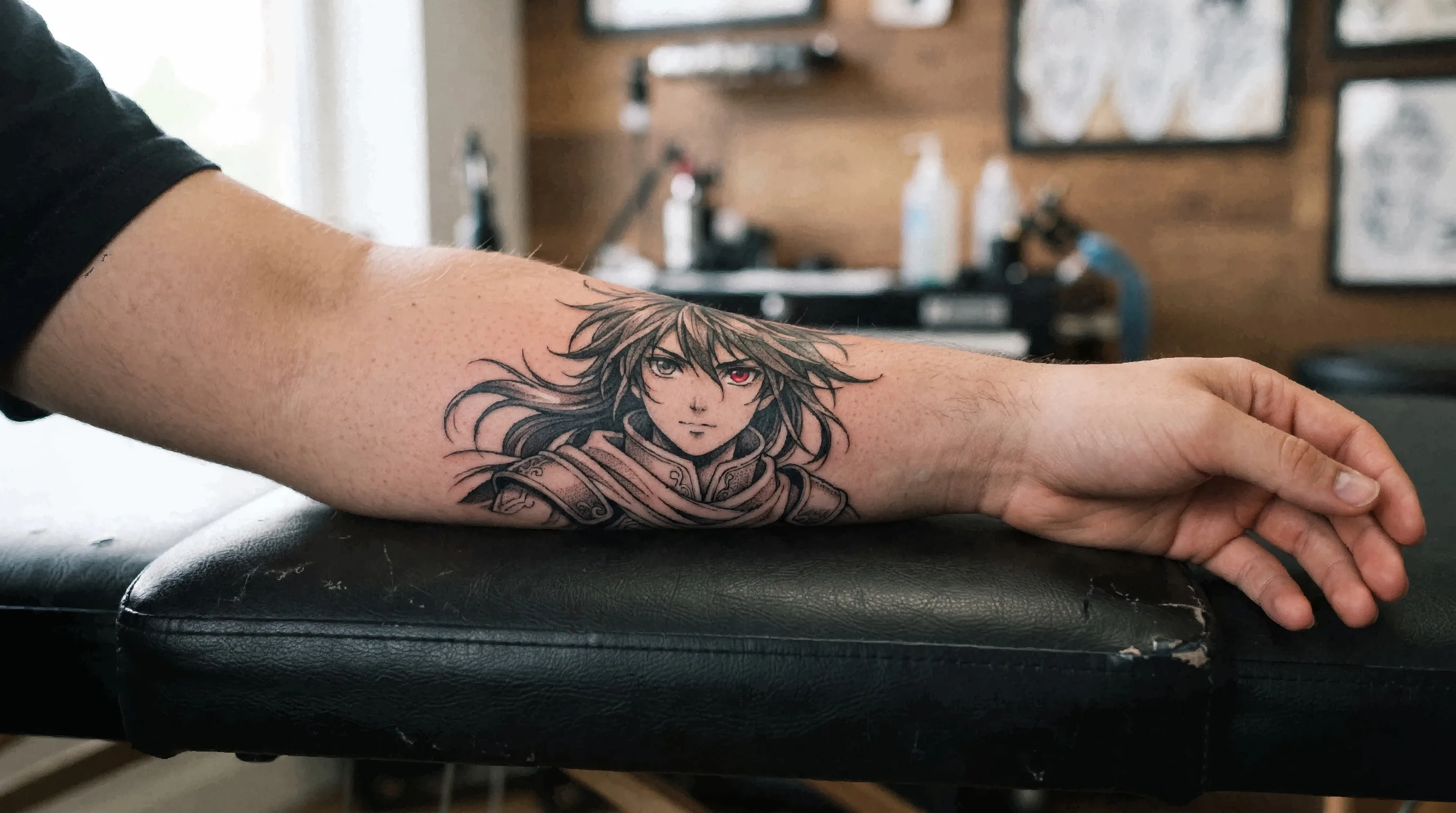
- Manga panel, black and grey. The most common style. Sharp inking, solid blacks, dot or line texture like a printed page, and sometimes torn panel edges or speech-bubble shapes. Colour is often limited to one accent, such as red eyes or an aura.
- Cel-shaded colour. Looks like a frame of the animation: bold outlines, flat areas of bright colour and crisp shadow shapes. It is striking when fresh and needs a strong outline to stay readable as it ages.
- Soft or watercolour anime. Characters with lighter outlines and washes of colour, closer to Studio Ghibli backgrounds or illustrated art books. Beautiful, but the softest elements fade first.
- Chibi and kawaii. Small, rounded, cute versions of characters with oversized heads. One of the few anime styles that genuinely works at a small size, because the design is simple by nature.
- Symbols and emblems. No character at all: a clan crest, a weapon, an item, a mark or a logo shape from the series. Subtle, ages well, and recognisable to anyone who knows.
- Anime and Japanese traditional fusion. A character framed by traditional waves, wind bars, clouds or flowers. Popular for sleeves and back pieces, and it needs an artist comfortable with both languages.
If you are torn between a colour piece and a black and grey one, our comparison of black and grey vs. colour tattoos goes through how each heals, ages and suits different skin tones.
Anime Tattoo Ideas That Work on Skin
A great anime tattoo is rarely a straight copy of a screenshot. Animation frames are designed to be seen for a fraction of a second on a backlit screen, and skin is neither. The ideas that hold up best tend to fall into a few groups:
- A character portrait with a clear expression. A head-and-shoulders or bust piece gives the face enough room to read. Pick an expression that sums the character up rather than a random still.
- A defining moment, simplified. A famous scene reduced to its strongest shape: a silhouette against a moon, a hand reaching out, a figure mid-transformation. Fewer elements, larger.
- An object instead of a person. A sword, a mask, a hat, a creature or a vehicle can carry a whole series and avoids the hardest part of anime tattooing, which is faces.
- A pair or a group. Two characters who belong together, or a small team. This needs real size, usually a forearm, calf or larger, so each face still works.
- A matching set. Friends or partners getting complementary characters or symbols. Agree on the style and artist together so the pieces actually match.
You can browse real anime tattoo ideas from artists on Tattooed.co, or look through anime tattoo flash for ready-made designs you can take to your artist as a starting point.
If you want to see a few rough directions before you talk to an artist, an AI sketch can help you decide what you like. Our guide to using AI to design your next tattoo explains how to use those sketches as reference rather than as the final design.
Size, Placement and How Anime Tattoos Age
Every tattoo line spreads slightly over the years. On a bold outline that change is barely noticeable. On an anime face, where the gap between an eye and its highlight might be a millimetre, it is the difference between a character and a smudge. That is why size matters more in anime work than in almost any other style.
- Faces need room. As a rough guide, a character's face should be at least the width of a large coin, and bigger is better. If an artist tells you a design needs to be larger for the detail to last, they are protecting you, not upselling you.
- Flat, wide areas suit it best. The outer forearm, upper arm, calf, thigh and back give an even surface for faces and clean shapes. Our tattoo placement guide covers how pain, visibility and stretching differ by area.
- Hands, fingers, ribs and feet are hard on detail. They move, rub and stretch, and fine features there blur sooner. Keep these spots for symbols or very simple chibi work.
- Bright colours fade first. Yellows, pinks and light blues soften faster than black, especially in the sun. A solid outline keeps a cel-shaded piece readable even as the colour mellows.
- Very thin linework is a gamble. Delicate manga lines look stunning on day one, but the same rules that apply to fine line tattoos apply here: give lines space and weight if you want them to last.
Sunscreen on healed tattoos is the single most useful habit for keeping colour bright. Our guide to preventing tattoo fading goes through the rest.
If you are thinking bigger, a series sleeve built from several characters needs a plan for how the pieces connect. See how to plan a tattoo sleeve before you book the first session.
Fan Art, Copying and Bringing Reference
Tattoos of anime characters are everywhere, and getting one for yourself is very common. Even so, many artists will not trace official artwork or a screenshot line for line. Some see it as a question of respect for the original artist, some as a matter of craft, and some simply know that a direct copy rarely makes a good tattoo. What most will happily do is draw their own version of the character, in their own hand, designed to fit your body.
That is usually the better result anyway. When you bring reference:
- Bring several images, not one. Different angles of the character, the expression you want, and an example of the art style you like (the manga, the anime, or a specific artist's take).
- Say what matters most. The eyes, the hairstyle, a scar, an outfit detail. Those are the things a fan will check first, so tell your artist which ones are non-negotiable.
- Say what you do not want. Too cute, too realistic, too much colour. This saves a round of redrawing.
- Leave room for the artist. They know how a design will sit on your arm and how it will age. The best anime tattoos usually come from a fan and an artist who have both had a say.
Our guide to the tattoo consultation covers what else to bring and the questions worth asking before you pay a deposit.
How to Find an Anime Tattoo Artist
This is the decision that matters most. Anime is a specialist style, and plenty of skilled artists who do beautiful traditional or realism work are not comfortable drawing manga faces. When you look at a portfolio, check for:
- Several anime pieces, not one. One great character could be luck. Five tells you it is something they do regularly.
- Faces that look right. Look closely at the eyes. Are both the same size and shape? Do the highlights match? Does the character look like themselves?
- Clean, steady lines and even colour. Cel shading depends on crisp edges and colour packed in without patches.
- Healed photos. Fresh tattoos always look sharp. Healed photos show you how the artist's work settles into skin, which is what you will live with.
- Their own drawings. Artists who post original anime-style sketches or flash are usually the ones who understand the style from the inside.
Our guide on how to read a tattoo portfolio goes deeper into spotting real skill behind a good Instagram feed, and how to find and choose the right tattoo artist covers the rest of the process.
On Tattooed.co you can find tattoo artists near you, look through their work, and contact the ones whose anime pieces stand out.
What Anime Tattoos Cost
Anime tattoos are priced like any other custom work: by size, detail, colour and the artist's rate. Prices vary a lot by city and by artist, so treat these as rough ranges rather than quotes.
- Small symbols or simple chibi pieces are often close to the shop minimum, commonly somewhere around $80 to $200.
- A palm-sized character portrait usually takes a few hours and often lands in the $250 to $600 range.
- Large pieces, half sleeves and full sleeves are normally charged by the hour or by the session, and can run well into the thousands over several visits.
Colour cel-shaded work tends to take longer than the same design in black and grey, because every area of colour has to be packed in solidly. Specialist anime artists with long waiting lists often charge more, and for a style this unforgiving, that is usually money well spent.
For the full picture of what goes into a price, read how much a tattoo costs, and check how tattoo deposits work before you book. If you already have an anime tattoo you are not happy with, a skilled artist can often rework it or design a cover-up.
Anime Tattoo FAQ
Can a tattoo artist copy an anime character exactly?
Many artists will not trace official artwork or a screenshot line for line, but almost all will draw their own version of the character for you. That usually makes a better tattoo, because the artist can adjust the pose, size and detail to suit your body and to age well. Bring several reference images and say which details matter most.
How much does an anime tattoo cost?
It depends on size, detail, colour and the artist. Small symbols or simple chibi pieces often cost close to the shop minimum, a palm-sized character portrait commonly falls somewhere around $250 to $600, and sleeves can run into the thousands over several sessions. Prices vary a lot by city and artist.
Do anime tattoos fade?
All tattoos soften over time, and anime tattoos show it most in small faces and bright colours. Yellows, pinks and light blues fade faster than black, and fine details close up as lines spread. A generous size, a solid outline and sunscreen on the healed tattoo keep an anime piece readable for many years.
What is the best placement for an anime tattoo?
Flat, wide areas such as the outer forearm, upper arm, calf, thigh and back suit anime best, because they give faces and clean shapes an even surface. Hands, fingers, ribs and feet are harder on fine detail and are better kept for symbols or simple chibi designs.
Should I get an anime tattoo in colour or black and grey?
Both work well. Black and grey suits manga-style inking, ages very steadily and tends to cost less. Colour cel shading looks like the animation itself and is more striking, but it takes longer and bright colours need more care to stay vivid. Choose the look of the source you love most, then find an artist whose portfolio is strong in that style.
Is it a good idea to include Japanese text in an anime tattoo?
It can be, as long as the text is checked by a fluent reader before it is tattooed. Mistranslations and characters written incorrectly are common, and very small Japanese characters blur quickly, so keep any text large enough for every stroke to stay clear.