Tattooing over a scar is one of the most common requests artists get, and one of the most commonly misunderstood. The internet is full of before-and-after photos that make it look effortless, and full of horror stories that make it look impossible. The reality sits between the two, and it hinges on one fact almost nobody explains up front: a tattoo changes the colour and pattern of a scar, not its texture. Once you understand what that does and doesn't buy you, the rest — how long to wait, which scars are workable, what designs actually cover, who to book — becomes much easier to judge.
What Scar Tissue Actually Does to Ink
Normal skin is organised. The dermis sits in a predictable band under the surface, its collagen laid down in a woven, flexible mesh, and it holds pigment in a stable, evenly distributed layer. That consistency is what lets an artist place a clean line at a consistent depth.
Scar tissue is the body's emergency repair, and it is built differently. The collagen is laid down in dense, parallel bundles rather than a woven mesh. Blood supply is often poorer. The tissue may be thicker than the skin around it (a raised scar), thinner (an indented or atrophic scar, which includes stretch marks), or both across different parts of the same mark. There are fewer of the structures that make normal skin behave predictably under a needle.
Four consequences follow, and every decision in this article traces back to them:
- Pigment retention is uneven. Some sections of a scar grip ink beautifully. Others reject a large part of it during healing and come back patchy. This is normal on scarred skin and is dealt with in a second pass — it is not a sign the artist did poor work.
- The depth window moves. The dermal target is shallower over thin scars and deeper under thick ones, and it can change within a single centimetre. That raises the risk of ink spreading sideways into looser tissue, the same mechanism behind a tattoo blowout, which is why fine linework over scarring is such a gamble.
- The tissue is more fragile. Scarred skin can break down, bleed, or weep plasma faster than normal skin, which limits how long an artist can work one area in a sitting.
- The texture stays. No amount of pigment fills an indent or flattens a ridge. This is the single most important thing to be clear about before you book.
How Long You Have to Wait
The usual minimum is twelve months, and many experienced artists prefer eighteen to twenty-four for significant surgical sites. But the calendar is a proxy for the thing that actually matters, which is whether the scar has finished changing.
A scar is ready when it is:
- Pale — silvery, white, or close to your skin tone, rather than pink, red, or purple. Colour means the tissue is still remodelling and still has heightened blood flow.
- Soft and flat-ish — it moves with the skin around it rather than feeling tight, hard, or cord-like.
- Quiet — no itching, tenderness, tingling, or sensitivity to touch.
- Stable — it looks the same in a photo taken today as one from three months ago.
A scar that fails those tests is still actively rebuilding, and tattooing it does two bad things at once: the fresh trauma can worsen the scar itself, and any ink you put in will shift as the tissue continues to settle. Waiting costs you months. Not waiting can cost you the option entirely.
Two additional cases need a doctor rather than an artist. If there are implants, surgical mesh, or reconstruction under the site, get your surgeon's clearance in writing before booking. And if you have an ongoing skin condition or take medication affecting healing or clotting, work through our guide to tattoos and health conditions first — those factors matter more on compromised tissue than they do on normal skin.
Which Scars Can Be Tattooed — and Which Shouldn't Be
Usually workable
- Mature flat surgical scars. A well-healed, pale, flat line — a C-section scar, an appendectomy, an orthopaedic incision — is the most straightforward category. Ink take is often close to normal, with some patchiness along the line itself.
- Stretch marks (striae alba). Very commonly tattooed and generally successful, provided they are mature: silvery-white and flat, not red, purple, or pink. The skin over a stretch mark is genuinely thinner than the skin beside it, so expect uneven take and a real blowout risk on fine detail.
- Flat atrophic scarring from acne, chickenpox, or minor injury. Small indents are easy to work around and disappear into a busy design.
- Mature self-harm scarring. An extremely common request, and many artists build a genuine speciality around it. Approach it exactly like any other scar work — the maturity tests above, an artist with healed examples, and a realistic design. A small number of studios have age or consultation policies around this work; that is a booking detail to check, not a judgement.
Case by case, with an experienced artist
- Hypertrophic scars — raised, but staying within the boundary of the original wound. Often tattooable once fully mature, but the raised surface distorts anything drawn across it and the tissue takes ink unpredictably. Design has to accommodate the ridge rather than ignore it.
- Burn scars and skin grafts. Specialist territory. Grafted skin is thin, has different blood supply, and can lack normal dermal structure entirely, so some areas hold almost no pigment. It is done, and done well, but only by artists with a real track record in it — and often over more sessions than anyone initially expects.
- Large or irregular scarring across a joint. Movement, tension, and stretching all work against retention here.
Where the answer is usually no
- Keloid scars. Keloids grow beyond the original wound boundary and keep growing. In someone prone to them, the trauma of tattooing can trigger fresh keloid formation — over the existing scar, and potentially in previously untouched skin. If you have ever formed a keloid, or have a family history of them, speak to a dermatologist before booking anything. An artist who declines this work is demonstrating expertise, not unhelpfulness.
- Anything still red, raised, itchy, tender, or under two years old on a major surgical site.
- Scars with active skin disease in or around them, or any area your doctor has told you not to traumatise.
What a Tattoo Can and Can't Hide
This is the expectation that most often goes wrong, so it is worth being blunt.
A tattoo changes colour and pattern. It does not change topography. A raised scar stays raised. An indented scar stays indented. Under angled light, or to the touch, or in a photograph with a hard side-light, the scar is still physically there — now with ink over it.
What good scar work actually achieves is different, and for most people it is the thing they genuinely wanted anyway: it stops the eye reading the scar first. A scar is conspicuous because it is a smooth, isolated shape in a different colour from everything around it, and the eye locks onto that. Break up the colour difference and surround it with pattern and the scar loses that isolation. From ordinary distance in ordinary light, most people simply see a tattoo.
The realistic outcome, then, is not erasure. It is a scar that no longer announces itself, on a piece of skin you now choose to show for a different reason. Go in expecting that and scar work very rarely disappoints. Go in expecting the scar to vanish and it always will.
Designs That Actually Cover Scarring
Design choice does more work here than any other single factor. The principle is simple: the design must give the eye somewhere else to go, and it must be forgiving of a surface that is not flat and ink that will not land perfectly evenly.
What works
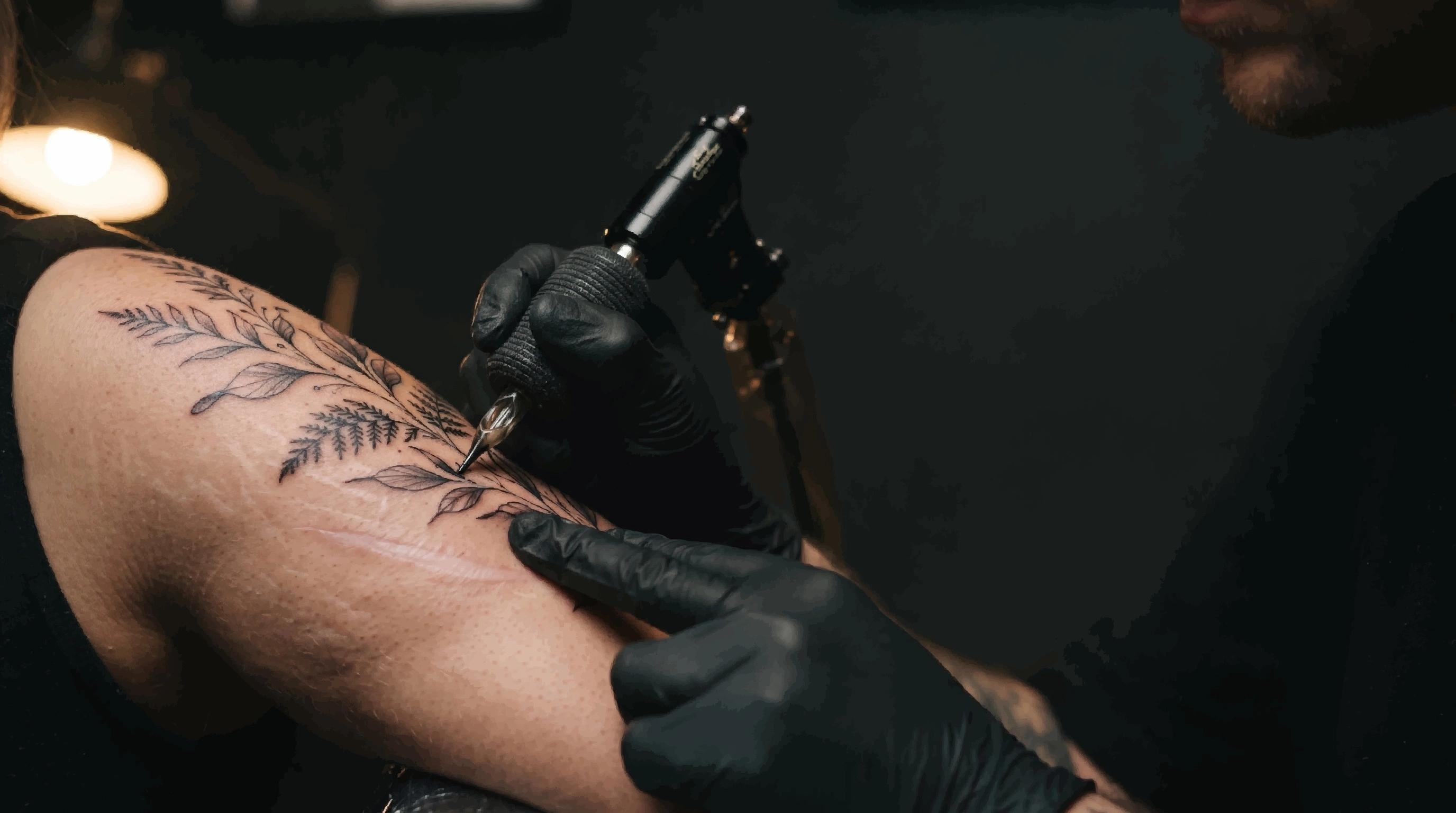
- Organic, irregular shapes. Botanical work, florals, foliage, waves, smoke, feathers, animal forms. Nothing in them is supposed to be symmetrical or perfectly straight, so a small distortion over a ridge reads as the drawing rather than as a flaw.
- Varied line weight and built-in texture. Stippling, whip shading, dot work, and deliberately broken linework absorb patchy retention. A design that already contains a hundred deliberate irregularities will absorb three accidental ones.
- Designs oriented along the scar, not across it. Running a stem, a branch, or the spine of a design roughly parallel to a linear scar lets the scar hide inside the structure of the piece. Cutting perpendicular across a ridge highlights it.
- Enough size and enough coverage. Scar work almost always wants to be bigger than the scar. A design that stops at the scar's edge frames it; a design that extends well past it in every direction absorbs it.
- Mid-tone density. Solid black hides colour differences well but shows surface texture more, and heavy packing is harder on fragile tissue. Broken mid-tones usually camouflage better than either extreme.
What doesn't
- Fine single-needle linework. The least forgiving option that exists, on the least forgiving skin. Uneven take shows as a broken line, and a small blowout ruins a thin line completely.
- Tight geometry and mandalas. Precise repetition is a measuring device. Any wobble over a ridge is instantly readable because the eye already knows what the shape should have been.
- Lettering and script. Same problem — you know what the letter shape is meant to be, so distortion and patchy fill are obvious. Our lettering and script guide covers why letterforms are so unforgiving generally; over scarring it is worse.
- Portraits and smooth realism. These depend on subtle, even gradients, which is exactly what scarred skin will not reliably hold.
- Skin-tone "camouflage" tattooing. Attempting to paint a scar out in flesh colour. It ages badly, tends to go yellow or grey as the surrounding skin changes with sun and time, and usually ends up more conspicuous than the scar was. This is a specialist paramedical procedure in a small number of hands and a bad idea nearly everywhere else.
If you are still deciding on direction, our guide to tattoo styles is a good starting point — filtered through the rule that texture-rich and organic beats precise and geometric on this kind of skin. The thinking overlaps heavily with covering an old tattoo, with one difference: an old tattoo is a colour problem, and a scar is a colour problem plus a surface problem.
Finding an Artist Who Does This Well
Scar work is a genuine sub-speciality. Plenty of excellent artists do not take it on, and that is fine — you want the ones who do it often, not the ones willing to try.
- Ask for healed photos of scar work specifically. Not fresh photos, and not their general portfolio. Fresh work over a scar looks great on day one and tells you nothing; healed work six months out tells you everything. If they have never posted scar work, they probably do not do much of it.
- Go in person for the consultation. An artist needs to see and feel the scar — its texture, how it moves, how thick it is — before committing to a design or a price. Anyone quoting confidently from a photo alone is guessing.
- Listen for realistic language. The right answer includes phrases like "we will do a lighter first pass and see how it holds", "this will take two or three sessions", and "the texture will still be there". Anyone promising it will disappear completely is either inexperienced or selling.
- Value a no. An artist who says your scar is not ready yet, or refers you to a dermatologist, or tells you the design you want will not work on that surface, is giving you the most useful information in the process.
- Consider a test patch. On extensive or unusual scarring — burns, grafts, large areas — some artists will tattoo a small section first and let it heal to see how the tissue behaves before committing to the full piece. It is worth the extra appointment.
Our guide to finding and choosing a tattoo artist covers the general vetting process; everything above sits on top of it, and none of it replaces it. You can also browse artists by location and work through their galleries with the healed-photo test in mind.
What the Session Is Actually Like
- It hurts differently, not simply more. Nerve endings regenerate unevenly after an injury, so parts of a scar are often numb or oddly muted while the border tissue around it can be sharper than normal skin. Your experience of previous tattoos is a poor predictor here, and so is the usual body-part pain map.
- It is slower. A careful artist works lightly over scar tissue, takes more breaks, and stops working an area sooner. Sessions often feel more tiring overall even where the peak intensity is lower than expected.
- Expect two or three sessions, not one. The standard approach is a lighter first pass to see how the tissue actually holds pigment, then building density once it has healed. Leave six to eight weeks between sessions rather than the usual four — scarred skin is slower to settle.
- Price it as a project. Ask at the consultation how the second and third passes are charged, and whether they are quoted as part of the piece or as separate sessions. This is not the same as a normal touch-up policy, because patchy retention on scarred skin is expected rather than exceptional. Get the answer before you start, not after the first heal.
- More plasma and more bleeding is normal on and around scar tissue, and it is part of why sessions run shorter.
Healing and Aftercare on Scarred Skin
The routine is the same as any other tattoo — our aftercare guide covers it in full — but the timeline and the expectations are not.
- Healing usually runs longer. Poorer blood supply means slower repair. Give it more time before judging anything, and cross-check against the normal week-by-week healing stages rather than against your last tattoo.
- Patchy areas at the four-week mark are expected. Do not panic, do not message your artist at day five, and do not book a fix elsewhere. Photograph it, wait the full six to eight weeks, and bring the photos to your next session.
- Watch for the scar reacting, not just the tattoo. Increasing raised thickness, spreading beyond the original boundary, or persistent itching weeks later is about the scar rather than the ink, and it warrants a doctor's opinion. Ordinary infection warning signs apply as normal on top of that.
- Be strict about sun. Scar tissue is more vulnerable to UV damage than the skin around it, and pigment held unevenly fades unevenly. Once healed, this is a piece worth protecting properly — our guide to preventing tattoo fading matters more here than on ordinary skin.
- Do not stretch, scrub, or pick. Standard advice, with higher stakes: the tissue underneath has already demonstrated how it responds to trauma.
Tattooing Over Scars FAQ
How long after surgery or an injury can you tattoo over a scar?
Twelve months is the usual minimum and many artists prefer eighteen to twenty-four, particularly for major surgical sites. The calendar matters less than the scar's condition: it should be pale rather than pink or red, soft rather than tight, no longer itchy or tender, and stable in appearance from month to month. If there are implants, mesh, or reconstruction underneath, get your surgeon's clearance as well.
Does tattooing over scar tissue hurt more?
It hurts differently rather than reliably more. Nerve endings regenerate unevenly, so parts of a scar are often numb while the border tissue around it can be sharper than normal skin. Sessions also tend to run longer and slower because the artist is working lightly, which can make the overall experience more tiring even where the peak intensity is lower. Your previous tattoos are a poor predictor.
Can you tattoo over stretch marks?
Yes, once they are mature, meaning silvery-white and flat rather than red, purple, or pink. The skin over a stretch mark is thinner than the skin beside it, so ink take is often uneven and the risk of a blowout is higher. Designs with organic shapes, varied line weight, and built-in texture cover them far more convincingly than fine linework or tight geometry. The tattoo hides the colour difference; the slight change in surface texture remains.
Will a tattoo completely hide a raised scar?
No. A tattoo changes the colour and pattern of skin, not its topography. A raised scar stays raised and an indented one stays indented, so under angled light or to the touch the scar is still there. What a good design does is stop the eye reading it as a scar first. From normal distance in normal light, most people will simply see a tattoo, which for most people is the actual goal.
Can you tattoo over a keloid scar?
This is the one category most experienced artists decline without a dermatologist's involvement. Keloids grow beyond the original wound boundary, and in someone prone to them the trauma of tattooing can trigger fresh keloid formation, over the existing scar and potentially in untouched skin as well. If you have ever formed one, or have a family history, get medical advice before booking, and treat an artist who refuses as one who knows what they are doing.
How many sessions does scar coverage usually take?
Plan for two or three rather than one. A common approach is a lighter first pass to see how the tissue actually holds pigment, then building density once it has healed, with six to eight weeks between sessions instead of the usual four. Patchy retention on the first pass is normal on scarred skin and is dealt with in the next session, so price the work as a multi-session project from the start.