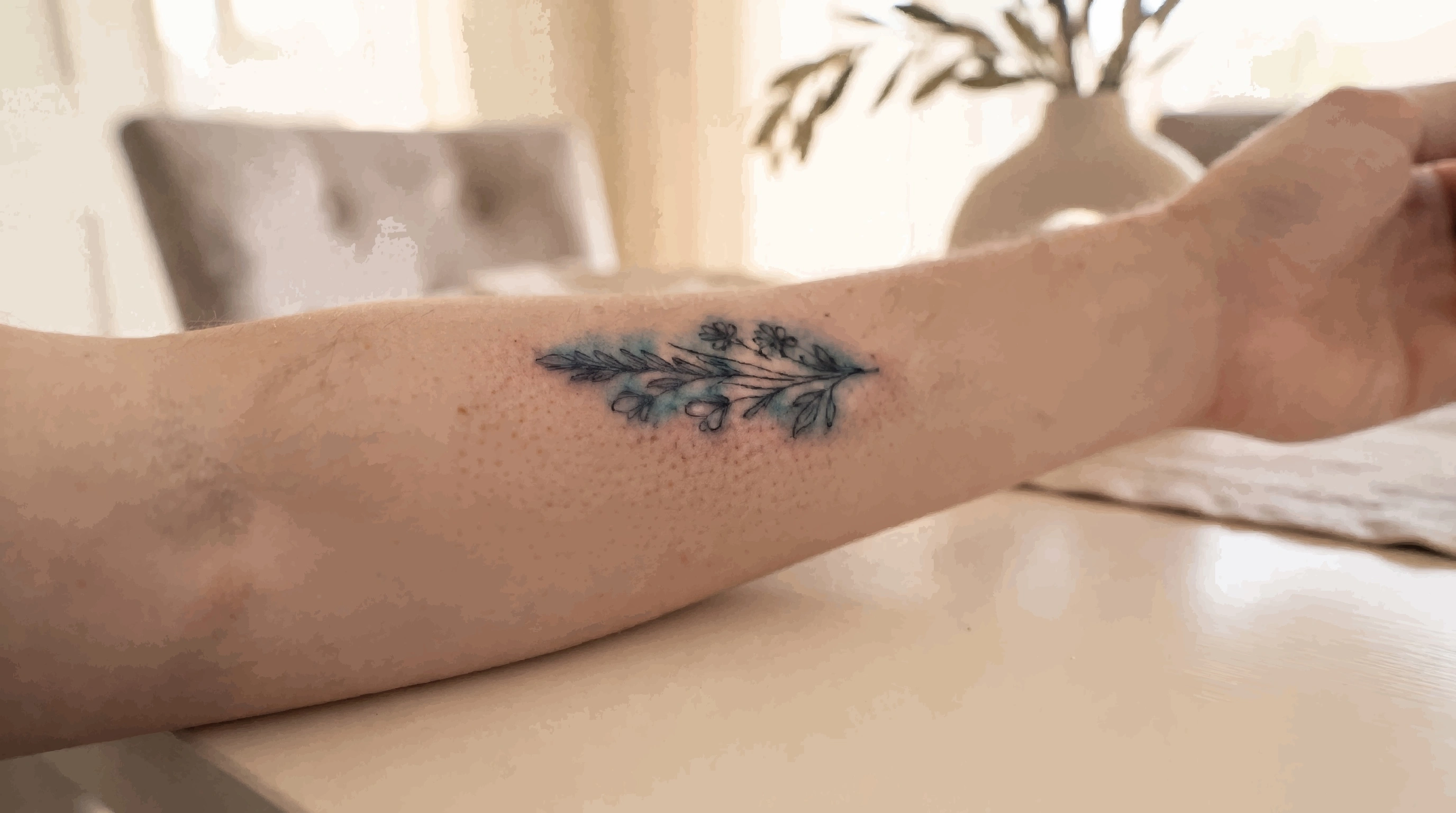
You booked a clean, crisp piece of linework. Three weeks later the swelling is gone, the flaking is done, and something looks wrong — a soft blue-grey haze bleeding out past the lines like ink on wet paper. That's a blowout, and it's one of the most common things people quietly panic about after a tattoo. The good news is that it's usually smaller than it feels, it's rarely a health problem, and there are real options. The honest news is that most of those options are about redesigning around it, not erasing it.
What a Blowout Actually Is
A tattoo lives in the dermis — the layer of skin sitting under the surface epidermis. That target window is thin, often only a millimetre or two, and it varies across your own body. Below it sits the subcutaneous layer: looser, fattier, far less structured tissue.
A blowout happens when the needle goes past the dermis and deposits ink into that looser layer. There's nothing holding the pigment in a tight line down there, so it spreads sideways through the tissue and settles as a diffuse cloud. Because you're then viewing it through more layers of skin, it reads as that characteristic muted blue-grey rather than solid black — the same optical effect that makes veins look blue.
Two things follow from that, and both matter:
- A blowout happens during the session, not during healing. Nothing you did or didn't do with your aftercare caused it. The ink was placed there the day you got tattooed — it just took a few weeks of swelling and redness going down for you to see it.
- The ink doesn't travel back. Once pigment is in that layer, it stays put. Any fix works by disguising it, breaking it up with a laser, or removing skin — never by waiting for it to migrate home.
Is It Actually a Blowout? Four Things It Gets Confused With
Plenty of people diagnose themselves with a blowout at day four and are completely fine by week six. Before you spiral, rule these out.
- Bruising. Heavy-handed work, a bony placement, or thin skin can leave a genuine bruise around the tattoo. It looks purple, red, or greenish-yellow rather than blue-grey, it's often tender, and it clears in one to two weeks. A blowout is painless and permanent.
- Normal healing haze. During the flaking and "silver skin" phase, almost every tattoo looks cloudy, dull, and slightly smudged. Knowing what each week of healing should look like saves an enormous amount of unnecessary worry here — that milky layer is regenerating epidermis, and it clears.
- Swelling. Fresh swelling stretches and distorts fine linework, especially on wrists, ankles, and fingers. Lines can look thick and mushy for the first week purely because the skin holding them is inflated.
- Infection. A blowout does not hurt, spread outward day by day, feel hot, or produce discharge. If any of that is happening, you're looking at a different problem — check the signs of an infected tattoo and see a doctor rather than an artist.
The practical rule: give it a full four to six weeks before you call it. If the haze is still there once the tattoo is fully settled, and it's a soft blue-grey extending beyond your lines with no pain attached, it's a blowout.
Why Blowouts Happen
Almost every cause traces back to needle depth or needle angle — and both are the artist's job to control. That said, some skin makes that job much harder than other skin.
- Depth. The single biggest factor. Going too deep pushes ink through the dermis. The margin for error is genuinely small, which is why depth control is the thing apprentices spend the longest getting right.
- Angle. A machine held too flat drags the needle sideways rather than driving it straight in, smearing pigment laterally. This is why blowouts often show up on one specific side of a line — the side the artist was pulling toward.
- Skin tension. Skin has to be stretched taut and held there while the needle works. Loose, unstretched skin moves with the needle and takes ink deeper than intended.
- Overworking. Repeatedly going back over the same line to darken it, or fighting a line that won't take, gradually pushes pigment through the floor of the dermis.
- Thin or loose placements. Inner wrist, top of the foot, ankle, inner bicep, elbow ditch, ribs, behind the ear, and fingers all have thin dermis, loose tissue, or both. These are where blowouts concentrate, and it's no coincidence that hand and finger tattoos have the worst reputation for it.
- Design choices with no margin. Very fine single-needle lines and tiny script have almost no tolerance. A blowout of half a millimetre is invisible on a bold traditional outline and catastrophic on a 2mm-tall letter. The same characteristics that make fine line work delicate are exactly what make it fragile here.
- Skin that behaves unusually. Very thin or mature skin, highly elastic skin, recent sunburn, and heavily stretched areas all shift where that dermal window sits. Alcohol and blood thinners make skin bleed and swell more, which makes reading depth harder in the moment.
How to Reduce the Odds Before You Get Tattooed
You can't control the needle. You can control almost everything upstream of it.
- Ask for healed photos of the same kind of work, on the same kind of placement. Not fresh photos — fresh work hides everything. If you want fine line script on your inner wrist, ask to see healed fine line script on inner wrists, months out. Our guide to finding and choosing a tattoo artist covers the wider vetting process; this is the placement-specific version of it.
- Take the size up. The most effective blowout insurance is scale. Bigger letters and slightly heavier line weight absorb a small amount of spread without anyone ever noticing. Tiny is where every millimetre counts.
- Respect the placement warnings. If an artist tells you fingers, the side of the wrist, or the inner bicep is a bad home for the design you want, that's not upselling. Placement genuinely changes how a tattoo ages, and this is one of the clearest cases of it.
- Show up in good condition. No alcohol beforehand, hydrated skin, no sunburn in the area, and a clear conversation about any blood thinners. All of it makes the skin easier to work on and easier to read depth on.
- Hold still and speak up. Flinching mid-line is a real cause. If you need a break, ask for one — that's normal and every artist expects it.
What You Can Actually Do About an Existing Blowout
Options run roughly from least to most invasive. Most people are best served near the top of this list, not the bottom.
1. Wait, then look again
Three months out, a lot of blowouts are noticeably less obvious than they were at week four. Surrounding trauma settles, contrast in the main lines strengthens, and the eye stops going straight to it. Nothing here is wishful thinking about ink moving — it's the rest of the tattoo catching up. Take a photo now so you're comparing to something real rather than to memory.
2. Accept it
This is a legitimate outcome and worth saying out loud. A faint halo you can only see at 20cm in good light, on a tattoo you otherwise love, is not worth a laser course and a rework. Almost nobody else will ever notice it. Tattoos are not vector graphics, and a small amount of imperfection is part of what a hand-made mark on skin looks like.
3. Rework by a skilled artist
The most common real fix. An experienced artist can pull the eye away from a blowout by thickening the affected lines, adding deliberate shading or black fill that absorbs the halo into the design, or redrawing the element so the blurred area reads as intentional soft shading.
Two cautions. First, this adds ink to skin that has already proven it blows out — the artist needs to be genuinely good, and it should usually not be the person who caused it unless you trust them completely. Second, reworks add weight; a design can only be thickened so many times before it stops being the design you wanted. Expect to pay for this like any other session unless it falls inside your artist's touch-up policy.
4. Cover-up or blast-over
For a bad blowout on a small piece, building something larger over the top is often cleaner than trying to repair it. A blowout is faint and diffuse, which makes it far easier to cover than a solid old tattoo — a blast-over or a design with enough black in the right places can swallow it completely. Our guide to cover-ups and blast-overs covers what's realistic and how to plan one.
5. Laser — full removal, or selective fading
Laser breaks pigment into fragments your immune system clears out. Two ways to use it here. You can remove the whole tattoo and start over. Or — more commonly — you can run a few sessions to fade everything down, then have the design cleanly redrawn on top, which lets the artist rebuild the lines without fighting the old ones.
Targeting only the halo while leaving the main line untouched is delicate, expensive, and not every technician will attempt it, since blown-out ink sits deeper and diffuse. Expect multiple sessions spaced six to eight weeks apart either way. Our laser tattoo removal guide covers pricing, sessions, and what removal actually feels like.
6. Surgical excision
Cutting the affected skin out and stitching it closed. Only viable for very small areas, only performed by a medical professional, and it trades a blurry tattoo for a permanent scar. It's the right call for almost nobody with a blowout, but it exists.
What Does Not Work
- Removal creams. They can't reach the dermis, let alone the layer below it. At best nothing happens; at worst the caustic ones cause chemical burns and scarring, and now you have a blowout and a scar.
- Salabrasion, sanding, or salt scrubs. Deliberately abrading skin to lift ink is a genuinely dangerous folk remedy — it causes infection and scarring, and blown-out ink is too deep to reach that way regardless.
- Exfoliating, oils, or "drawing out" the ink. Pigment in the subcutaneous layer is not coming up through the surface. Nothing topical changes it.
- Tattooing skin-toned ink over it. Skin-tone cover-ups age badly, go yellowish or grey, and almost always draw more attention than the blowout did.
How to Bring It Up With Your Artist
Blowouts are an uncomfortable conversation because they sit somewhere between a mistake and an occupational hazard. A few things make it go better.
- Wait until it's healed. Messaging at day five about swelling reads as panic and puts the artist on the defensive. At six weeks you have something real to show.
- Lead with a photo and a question, not an accusation. "Here's how it healed — is this something you'd want to look at?" gets a far better response than a demand.
- Know what's reasonable. Many artists will rework a genuine blowout free inside their touch-up window, because their portfolio is on the line too. Some won't, and that isn't automatically bad faith — thin-skin placements and fine line work carry known risk that a good artist may have warned you about at the consultation.
- You're allowed to go elsewhere. If the work was poor overall, or the response is dismissive, take the piece to someone whose healed portfolio you trust. Paying a second artist to fix it is a normal outcome, not a failure on your part.
Refunds are rare in tattooing and generally aren't the goal worth chasing. What you actually want is a tattoo you're happy to look at — which usually means a rework or a cover-up, not money back. If a piece has left you genuinely unhappy rather than mildly annoyed, give it a few months before committing to anything you can't undo.
Tattoo Blowout FAQ
Do tattoo blowouts go away on their own?
No. The pigment is sitting in the layer below the dermis and it doesn't migrate back or clear itself. What does change is how noticeable it looks: swelling and trauma settle over the first few months, contrast in the main lines strengthens, and a lot of minor blowouts become far less obvious by month three without anything being done. That's the tattoo settling around it, not the blowout healing away.
How soon can you tell if it's a blowout?
Give it four to six weeks. Before that, swelling, bruising, and the cloudy "silver skin" stage of healing all mimic a blowout convincingly. Once the tattoo is fully settled, a blowout shows as a soft blue-grey haze extending past your lines that doesn't hurt, doesn't feel warm, and doesn't change day to day. If it's tender, hot, spreading, or weeping, that's a possible infection rather than a blowout and it needs a doctor.
Can a tattoo blowout be fixed or covered up?
Yes, though "fixed" usually means disguised rather than erased. The common routes are a rework that thickens the linework or adds shading to absorb the halo, a cover-up or blast-over that builds a larger design over the top, or laser sessions to fade the area before it's redrawn. Blown-out ink is faint and diffuse, which actually makes it easier to cover than a solid old tattoo. Wait until the piece is fully healed before committing to any of it.
Is a blowout the artist's fault?
Usually, in the sense that needle depth and angle are the artist's job to control. But it isn't always negligence. Thin-skin placements like fingers, inner wrists, and the inner bicep, plus very fine linework with no margin for error, carry real risk even in skilled hands — which is why a good artist raises it at the consultation. A reputable artist will often rework a genuine blowout inside their touch-up window; a pattern of blowouts across their healed portfolio is a different signal entirely.
Are blowouts more common on certain body parts?
Very much so. Fingers, hands, inner wrists, tops of feet, ankles, inner biceps, elbow and knee ditches, ribs, and behind the ear all combine thin dermis, loose tissue, or skin that's hard to stretch taut. Those are the placements where blowouts concentrate. Going slightly larger with slightly heavier line weight is the most reliable way to build in tolerance if you want ink in one of those spots anyway.