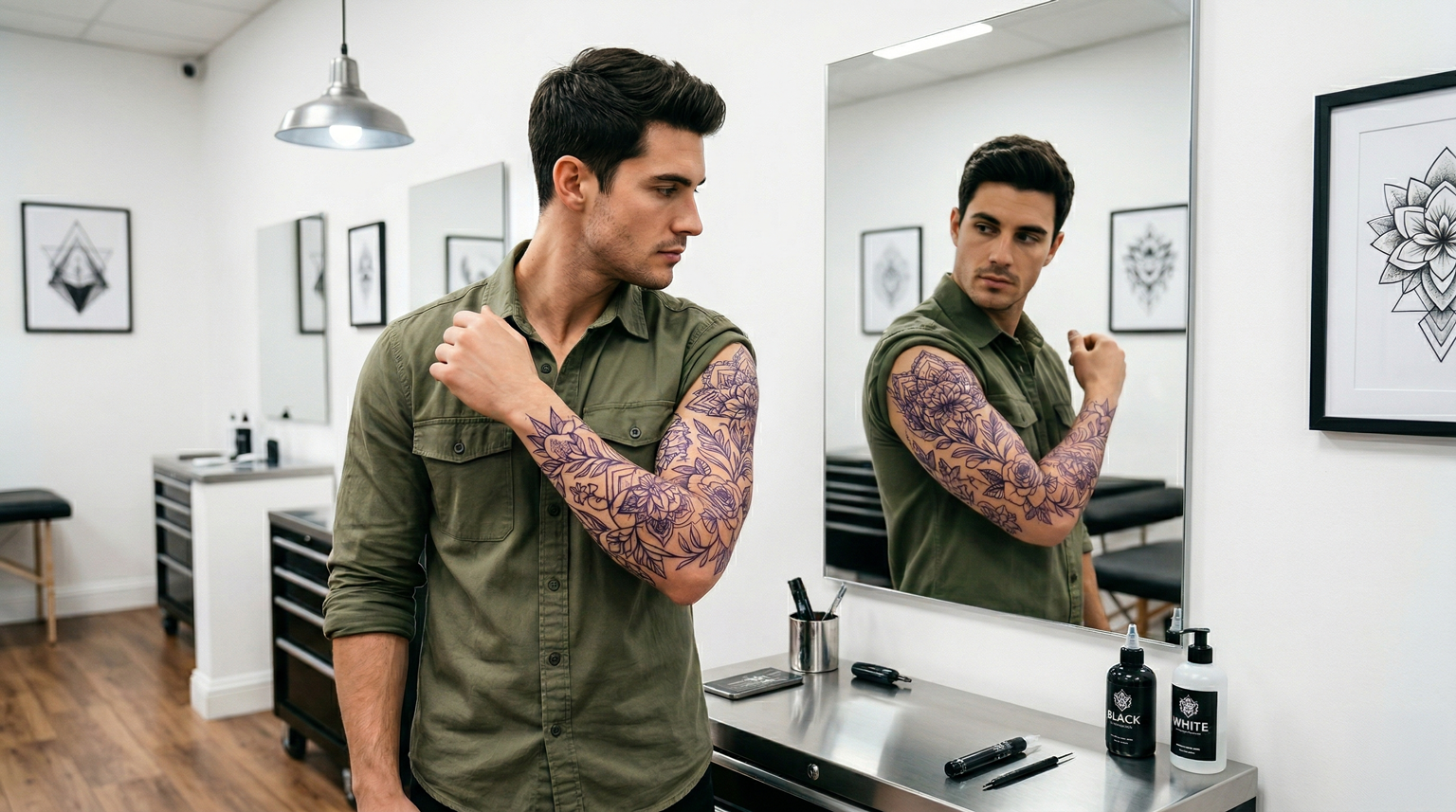
A tattoo sleeve is one of the most ambitious commitments in body art. Done well, it's a cohesive, wearable piece of art that tells a story across your entire arm. Done without a plan, it can become a collection of disconnected pieces that never quite work together. This guide covers everything you need to know before your first session.
What Exactly Is a Tattoo Sleeve?
A tattoo sleeve is a large tattoo (or collection of tattoos) that covers most or all of one arm. There are three main types:
- Full sleeve: Wrist to shoulder, covering the entire arm
- Half sleeve: Either wrist to elbow, or elbow to shoulder
- Quarter sleeve: Covers roughly the upper arm or just below the elbow
Sleeves can be built as a single unified composition designed from the start, or assembled over time by connecting existing tattoos. Both approaches work — but they require very different planning strategies.
Step 1: Choose Your Style First
The single most important decision you'll make is picking a consistent style. A sleeve with traditional roses next to micro-realism portraits next to geometric dotwork rarely looks intentional — it looks like three different artists worked on three different people. Cohesion comes from style consistency.
Some of the most popular sleeve styles and why they work well:
- Japanese (Irezumi): Built for sleeves. The style is specifically designed to flow around the body using wind, waves, clouds, and negative space as connective tissue. Koi, dragons, tigers, and peonies are natural sleeve subjects.
- Traditional / Neo-Traditional: Bold outlines and strong color fills hold up well over time and work seamlessly across multiple sessions with multiple artists.
- Blackwork / Ornamental: High contrast and pattern-based design makes it easier to connect pieces over time without visible gaps.
- Realism / Black & Grey: Can produce stunning sleeves, but requires a single highly skilled artist executing the entire arm — mixing realism artists almost always shows.
- Patchwork: Intentionally mismatched smaller pieces. This is the exception to the cohesion rule — patchwork works because the "scattered" look is the style.
Step 2: Decide Between a Concept Sleeve and a Patchwork Sleeve
Before you talk to an artist, decide which approach fits you:
- Concept sleeve: A single unified theme runs through the entire arm. The artist designs the full composition before tattooing begins. Every element is placed deliberately to flow into the next. Requires one artist (or a team that communicates closely).
- Patchwork / collection sleeve: Individual pieces are added over time, often from different artists. The style is consistent, but pieces don't need to touch or share a background. Good for people who want flexibility over the years.
Neither approach is better than the other, but knowing which one you're building changes how you plan and who you hire.
Step 3: Think About Flow and Anatomy
A great sleeve doesn't ignore the arm — it uses it. Your elbow, wrist, and shoulder are design elements, not obstacles. Here's how to think about each zone:
- Elbow ditch (inner elbow): Painful, fades faster, and skin moves constantly. Bold, simple elements work better here than delicate detail. Often used as a focal point or natural break in the composition.
- Forearm: One of the best canvases on the body. High visibility, relatively flat, and heals well. Often the starting point for sleeves.
- Upper arm (bicep/tricep): Large surface, great for detail. The curve of the bicep means designs need to wrap — flat designs placed here can look distorted.
- Wrist / near the hand: High friction and sun exposure. Bold, simple linework holds better than fine detail in this area.
- Shoulder cap: A natural anchor point. Many sleeves start here or end here with a strong focal element.
Experienced sleeve artists understand how to use negative space, background elements (clouds, waves, smoke, geometric fills), and shading transitions to move the eye around the arm naturally. This is not something you should attempt to plan alone with a sketch on paper — it's a conversation with your artist.
Step 4: Plan Your Sessions and Budget Realistically
A full sleeve is not a one-session project. Most full sleeves take anywhere from 15 to 40+ hours of tattooing time, depending on the style, detail level, and color versus black & grey. Here's what to budget for realistically:
- Half sleeve (black & grey, moderate detail): 8–15 hours / $800–$2,500+
- Full sleeve (color, high detail — e.g., Japanese): 20–50 hours / $2,000–$8,000+
- Patchwork sleeve (accumulated over time): Variable, but multiple short sessions
These ranges vary enormously by artist experience, location, and demand. Top sleeve artists often charge $200–$400+ per hour. Budget for more sessions than you think you'll need — healing, touch-ups, and design changes always add time.
Step 5: Find the Right Artist for a Sleeve
Not every talented tattoo artist is a good sleeve artist. Sleeves require:
- Compositional thinking — designing across a 3D curved surface, not a flat page
- Long-session endurance — both physically and creatively
- Consistent style execution — the piece done in session 1 needs to match session 12
- Experience with flow — knowing how to connect elements so the arm reads as one piece
When evaluating artists, specifically look for:
- Completed (not just started) full sleeve examples in their portfolio
- How they handle the elbow and wrist transitions
- Whether background elements (waves, clouds, smoke, fills) are cohesive or patchy
- Healed photos — not just fresh work
The artist for your sleeve may not be the same artist who does your single pieces. That's completely normal. Treat sleeve selection as its own search process.
Step 6: Start with a Consultation, Not a Commitment
Before booking your first sleeve session, book a consultation. Bring:
- Reference images of sleeves you like (whole arms, not just individual pieces)
- Reference for any specific elements you want included
- A clear idea of your style direction
- Any existing tattoos that need to be incorporated
A good sleeve artist will ask about your lifestyle (how much sun exposure, your job, long-sleeve requirements) and may take photos of your arm before designing anything. They should propose a rough layout before any stencils touch your skin. If an artist is ready to start tattooing your sleeve without any discussion of composition, that's a red flag.
Connecting Existing Tattoos Into a Sleeve
If you already have arm tattoos and want to build around them, it's absolutely possible — but it changes the design challenge. An experienced sleeve artist will assess:
- Whether existing tattoos need reworking, touching up, or laser fading first
- What style and subject matter can realistically incorporate the existing pieces
- How to use background elements or framing to make existing tattoos feel intentional
It's rare that a mixed bag of old tattoos can't be worked into a sleeve — but honesty from your artist matters here. If they say a piece needs to be changed before the sleeve can work, trust their eye.
Common Sleeve Planning Mistakes
- Starting without a plan and hoping it comes together: It rarely does
- Changing artists mid-sleeve without a clear handoff: Style drift is real
- Underestimating budget and ending up with a half-finished sleeve for years: Plan your sessions and finances together
- Mixing too many unrelated styles: Cohesion is the difference between a sleeve and a collection of tattoos
- Going too small with detail in high-movement areas: Elbow ditch and wrist details fade faster than anywhere else
- Rushing the healing between sessions: Each session adds trauma to healing skin — respect the timeline
Final Thoughts
A well-planned tattoo sleeve is a long-term project that rewards patience. The artists who build them well are specialists who think about composition, longevity, and the three-dimensional nature of the arm. Take time to find the right one.
Tattooed.co is a great place to browse tattoo artist portfolios by location and specialty. Filter by style and review completed sleeve work before reaching out for a consultation. The right sleeve artist is worth waiting for.