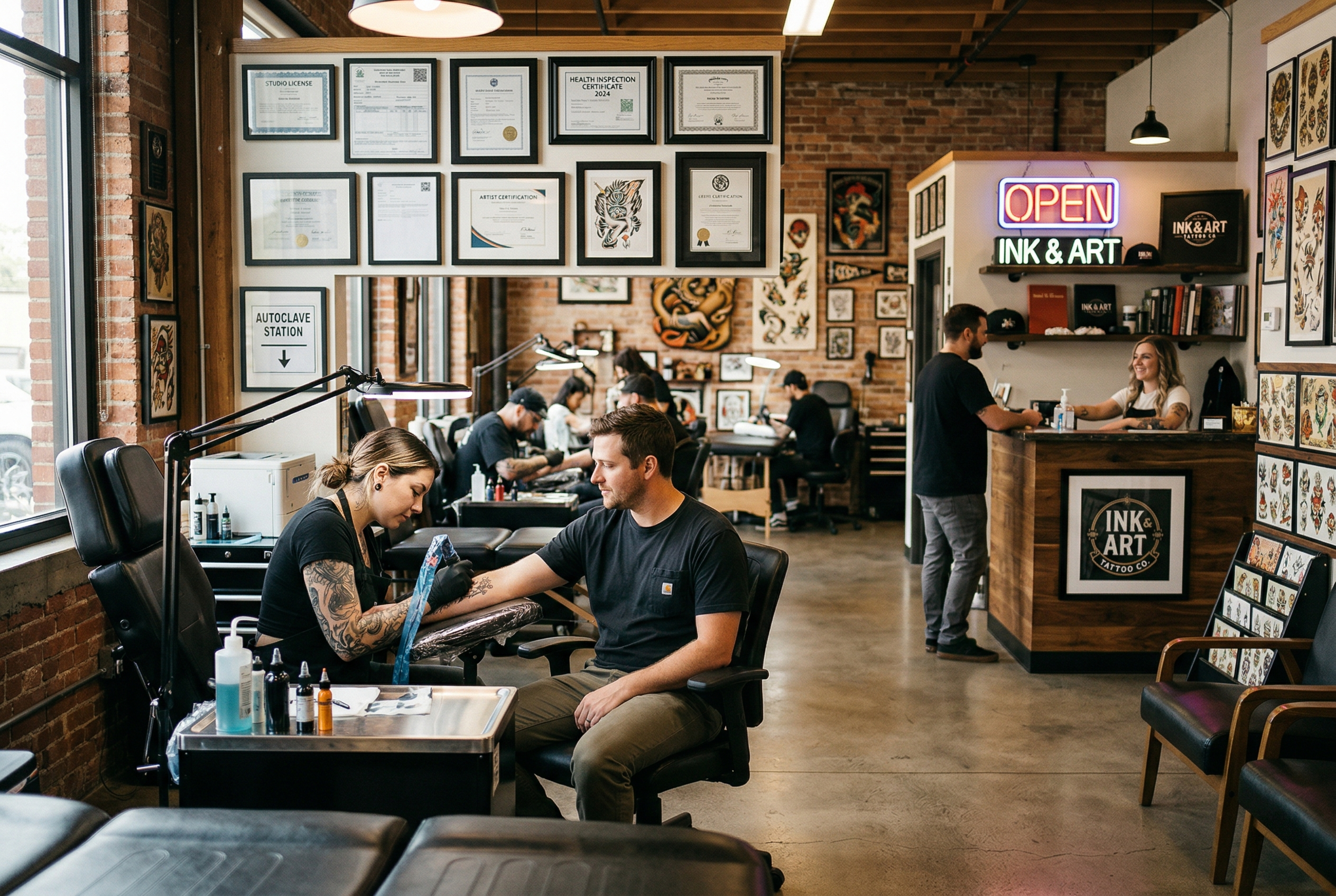
Opening a tattoo shop is one of the most rewarding things you can do in this industry — and one of the most complicated. Between health department regulations, build-out costs, staffing, and finding clients, there is a lot more going on than putting a sign in a window. This guide walks through everything you need to know before you sign a lease.
Step 1: Do Your Market Research Before Anything Else
Before writing a business plan or looking at spaces, spend time understanding the market you are entering. Visit tattoo shops in your area as a customer. Look at what they do well and where they fall short. Ask yourself:
- How many shops are within 5 miles? Are they busy?
- What styles are already well-represented locally? What is underserved?
- Is your target neighborhood growing, stable, or declining?
- Who is the clientele — college town, suburban, urban professional, tourist heavy?
A shop that would thrive in a college neighborhood might struggle in a suburb with an older demographic. Your concept, pricing, and artist roster should match the real market, not the market you imagine.

Step 2: Write a Realistic Business Plan
A business plan is not just for getting a bank loan — it forces you to stress-test your idea before spending money. At a minimum, your plan should cover:
- Startup costs: Lease deposit, build-out, equipment, permits, insurance, signage, website
- Monthly operating costs: Rent, utilities, supplies, credit card processing, software
- Revenue model: How many artists, average ticket size, booth rent vs. commission split
- Break-even analysis: How many tattoos per week do you need to cover your fixed costs?
- Runway: How many months of operating expenses do you have saved before the shop needs to be profitable?
A realistic startup budget for a small shop (2–4 stations) in most US markets runs between $30,000 and $80,000 depending on the condition of the space, the cost of equipment, and local permit fees. Shops in major metro areas can cost significantly more.
Most new shops take 6 to 18 months to reach consistent profitability. Build that expectation into your plan.
Step 3: Understand the Licensing and Permit Requirements
This is the area where most first-time shop owners underestimate the complexity. Requirements vary significantly by state, county, and city, but here is what you will typically need:
Business Formation
- Register your business entity (LLC is the most common for tattoo shops — it separates personal liability)
- Obtain a federal Employer Identification Number (EIN) from the IRS
- Register with your state for sales tax collection if applicable
- Open a dedicated business bank account
Tattoo Shop Permit / Body Art Establishment License
Almost every state requires a separate permit specifically for tattoo establishments, issued by the state or county health department. Requirements typically include:
- A physical inspection of the premises before opening
- Proof that the space meets minimum sanitation standards (autoclave, sharps disposal, hand-washing sinks at each station)
- Written infection control and bloodborne pathogen procedures
- Artist-level permits for every tattooer working in the shop (separate from the shop permit)
Contact your county health department early — inspections often have wait times of 4 to 8 weeks and you cannot legally operate without approval.
Individual Artist Permits
Most states require each tattooist to hold their own license or registration, which typically requires proof of bloodborne pathogen training (usually an 8-hour course), a first aid certification, and a fee. Some states also require an apprenticeship period. If you are opening as a working artist-owner, you need both the shop permit and your personal artist permit.
General Business License
Your city or county may require a general business license separate from the tattoo-specific permit. This is usually straightforward — a one-page form and a small annual fee — but do not skip it.
Zoning Approval
Verify that the space you are considering is zoned for a tattoo shop. Most commercial zones allow them, but some municipalities have restrictions around schools, churches, or residential areas. Check with your city planning office before signing a lease.
Step 4: Find the Right Space
Your location affects everything — foot traffic, clientele, rent, and the quality of artists you can recruit. When evaluating a space, consider:
- Size: A minimum of 200 sq ft per station is a good baseline. Add room for a waiting area, front desk, sterilization area, and a private room for sensitive placements.
- Plumbing: Every station should have direct access to a hand-washing sink. Retro-fitting plumbing is expensive — factor this into negotiation if the space lacks it.
- Ventilation: Health departments often require adequate ventilation. Basement spaces can be tricky to get approved.
- Visibility and signage rights: Can you put signage on the exterior? Is the shop visible from the street or does it depend on word of mouth to be found?
- Parking: Tattoo sessions can run 4 to 8 hours. Accessible parking matters.
- Lease terms: Negotiate a build-out allowance if the space needs significant work, and avoid leases shorter than 2 years — you need stability while you build your reputation.
Step 5: Design and Build Out Your Space
The physical design of your shop communicates your brand before a client ever sits in a chair. A clean, well-designed space attracts better artists and commands higher prices. Key areas to plan:
- Tattoo stations: Each needs a client bed or chair, artist stool, work surface, task lighting, power outlet access, and a hand sink nearby. Privacy curtains or partitions are appreciated by clients getting placements in sensitive areas.
- Sterilization area: Dedicated space for your autoclave, ultrasonic cleaner, packaging supplies, and sharps disposal. This area must be clearly separated from the tattooing area.
- Front desk and waiting area: The booking experience starts here. A clean, well-organized front desk and comfortable waiting area sets the tone.
- Art and atmosphere: Display artist portfolios, flash sheets, and original art on the walls. Your shop's aesthetic is a direct sales tool.
Step 6: Equipment and Supplies
Starter equipment costs vary but budget for quality. Cutting corners on sterilization equipment specifically is not an area to economize — your health department will inspect it.
- Autoclave (sterilizer): $500–$2,500+ depending on capacity
- Ultrasonic cleaner: $100–$400
- Client chairs or beds (per station): $200–$800 each
- Artist workstations: Carts, tables, lighting — $150–$400 per station
- Stencil printer: $200–$600
- Sharps containers and biohazard disposal service: Ongoing monthly cost
- Supply inventory: Inks, needles, grips, barriers, gloves, aftercare products
- Booking software: Platforms like Vagaro, Square Appointments, or Tattooed.co for managing appointments and deposits
Step 7: Get the Right Insurance
Tattoo shops require several types of coverage. Do not open without them:
- General liability insurance: Covers bodily injury and property damage claims. Required by most landlords and essential for any shop.
- Professional liability (malpractice) insurance: Covers claims related to the tattooing service itself — allergic reactions, infections, unsatisfactory results.
- Workers' compensation: Required if you have employees (artists on payroll, not booth renters).
- Property insurance: Covers your equipment, fixtures, and inventory in case of fire, theft, or vandalism.
Several insurance providers specialize in tattoo shops — they understand the specific liability exposure and can bundle policies. Expect to pay $150–$500 per month for a well-covered shop.
Step 8: Build Your Artist Roster
Whether you bring in artists as booth renters or employees fundamentally changes how you run the shop:
- Booth rental: Artists pay you a flat weekly or monthly fee for their station and run their own business. You are not responsible for their taxes, scheduling, or clients. This is by far the most common model for tattoo shops.
- Commission split: The shop takes a percentage of each tattoo (typically 40–60% to the artist, remainder to the shop). Higher overhead for the shop but more control and a share of every booking.
- Employee: Artists on salary or hourly wage. Rare in most shops due to the administrative overhead, but useful for shops that want full schedule control.
Start with artists you trust. Bringing in friends or people with established clientele gives you immediate revenue and a known quantity. Recruiting cold takes longer and carries more risk.
Every artist in your shop is a reflection of your brand — their work will be on your walls, your social media, and your Google reviews. Quality over quantity, especially at the start.
Step 9: Set Up Your Online Presence Before Opening Day
New shops are researched online before anyone walks through the door. Have these live before your first client appointment:
- Google Business Profile: Claim and complete it. This is how most local clients find you.
- Instagram: Post artist work, your space, and behind-the-scenes content regularly
- Website: At minimum, a page with your artists, location, and a booking link
- Tattooed.co listing: List your shop so clients searching by city and style can find you
- Booking system: Allow online deposits at the time of booking — it dramatically reduces no-shows
What the First Year Actually Looks Like
Honesty matters here. Most new shop owners describe their first year as the hardest thing they have done professionally. Common realities:
- The first 3 months are usually the slowest — building awareness takes time
- Artist turnover is normal; some of your initial roster will leave or not produce what you expected
- Unexpected costs appear constantly — equipment breaks, permits require amendments, build-outs run over
- You will spend far more time on administration, client communication, and maintenance than on tattooing
- Your Google reviews will define your reputation early — one or two bad experiences in the first few months can stall growth
The shops that survive their first year are the ones that planned for adversity, maintained cash reserves, and stayed focused on building quality and reputation over volume.
Common Mistakes First-Time Shop Owners Make
- Underestimating startup costs: Always add 25% to your initial budget estimate
- Opening before permits are fully in place: Operating without a health department permit puts your entire investment at risk
- Overstaffing too early: Two or three artists covering their booth rent is better than six artists in a shop that feels empty
- Neglecting the online presence: Clients look at Instagram and Google before they ever call
- No deposit policy: Requiring a deposit on every booking is one of the most important policies for protecting your artists' time
- Skipping the business entity and insurance: A single liability claim can end an unprotected shop
Final Thoughts
Opening a tattoo shop takes more planning and capital than most people expect — but the shops that do it right build lasting businesses with strong reputations and loyal clientele. Take the time to understand the regulations in your specific state, choose your location and team carefully, and give yourself enough runway to grow properly.
Tattooed.co is designed to help shops like yours get discovered by local clients searching for artists and studios. Once you are open, list your shop on Tattooed.co to start connecting with clients in your area.